Dog Kennel Flooring: A Commercial Buyer's Guide for Boarding, Breeding, and Shelter Operators
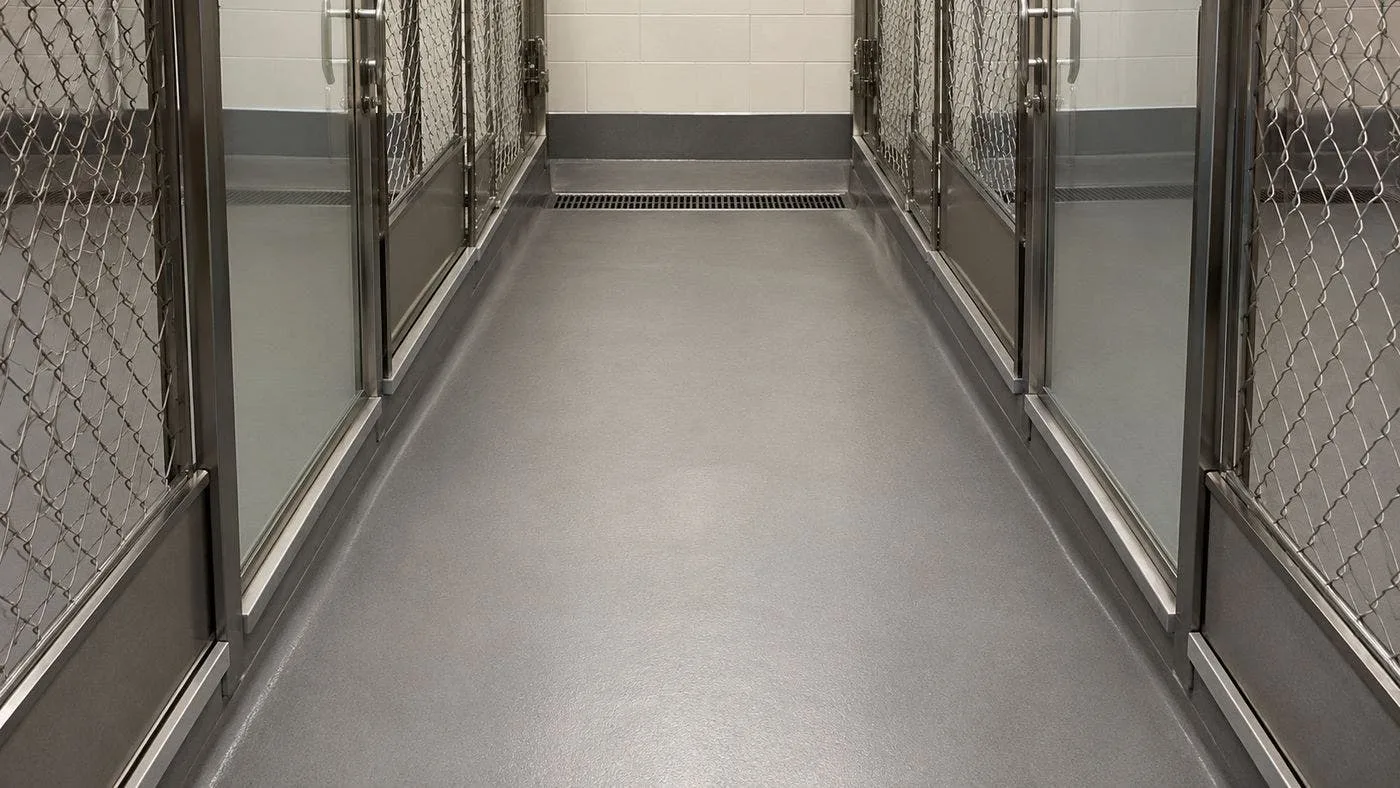
Dog kennel flooring is commercial-grade flooring specified to survive six stacked wear conditions that very few commercial spaces impose all at once: daily urine exposure, frequent washdowns, drainage, claw and impact damage, 8 to 12 hours of daily animal occupancy, and barking noise. For the wet zones where animals relieve themselves and floors get washed down, the right answer is a sealed, non-porous surface: vinyl-surfaced rubber rolls with welded seams, or 100% vinyl rolls. Standard recycled rubber rolls earn their place in dry rest and comfort zones, where their cushioning and sound absorption do their best work.
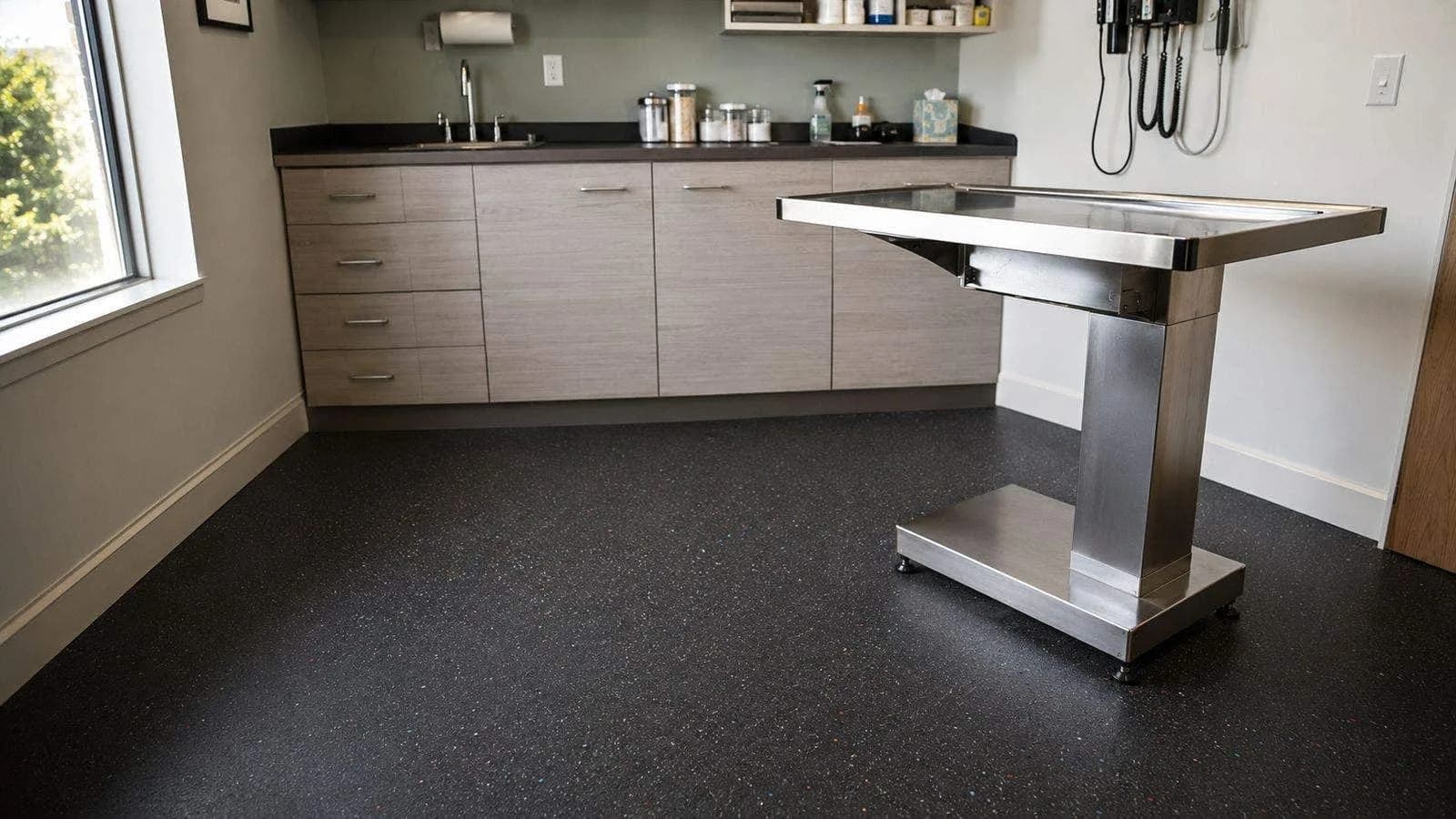
A kennel floor lives a harder life than a vet exam room. It gets washed down, urinated on, scratched at, and slept on every day, for years. If you specify it like a clinic floor or a retail floor, you get a year or two before the seams lift and the urine smell never quite leaves.
FlooringInc has been selling commercial flooring for over 18 years and works directly with the major manufacturers across rubber, vinyl, and specialty categories, including our own dog kennel flooring collection. Kennels and boarding facilities are a real part of our commercial business, and they remain one of the most under-served verticals in the market. We wrote this guide for the buyers who keep calling us with the same questions.
This guide is for boarding facility owners, breeders running production kennels, animal shelters, dog daycare operators, vet practices adding a boarding wing, and the architects and contractors specifying dog boarding facility flooring for any of them. If you're building or refreshing the veterinary clinic itself, the partner guide is our veterinary clinic flooring guide. And if you're outfitting a home kennel or daycare playroom rather than a commercial build, our consumer-focused dog kennel flooring ideas post is the better starting point.
Why Dog Boarding Facility Flooring Is Its Own Category
A kennel floor has to survive six wear conditions stacked on top of each other in a way that almost no other commercial space asks of a floor. Most floors are designed for one or two of them. Kennels need all six at once.
The six conditions:
- Urine and waste exposure, continuous and daily.
- Cleanability under washdown, often twice a day.
- Drainage, whether trench drains, slope-to-drain, or none at all.
- Claw resistance and impact tolerance, with active dogs on the floor 8 to 12 hours a day.
- Comfort for prolonged occupancy, because animals sleep here.
- Noise reduction, because barking on a hard floor turns the whole building into an echo chamber.
This is also where kennels and vet clinics part ways. A vet exam room is mopped a few times a day. A kennel run is washed down end-to-end, and the water has to go somewhere. That changes the floor spec entirely.
A kennel is not a hospital. It's a workhorse environment with hospital-grade hygiene expectations and zero room for floor failure.
One note on scope: this guide covers indoor kennel runs and boarding wings. Outdoor kennel flooring, meaning runs, yards, and play areas exposed to weather, is a different spec built around drainage-first products like pet turf and perforated drainage tiles, and it deserves its own guide.
The Six Wear Conditions: A Material Matrix
The fastest way to specify kennel flooring is to map each wear condition to the material that handles it best. Start with the condition instead of the material and the right product is usually obvious.
| Wear condition | What it does to the floor | Materials that handle it well | Materials to avoid |
|---|---|---|---|
| Urine and waste | Penetrates pores and seams, stains, leaves residual smell | Sealed-surface rolls (vinyl-surfaced rubber with welded seams, 100% vinyl rolls), epoxy, sealed concrete | Standard recycled rubber rolls (semi-porous), LVT and SPC (seams), carpet |
| Washdown | Water works under seams and through gaps | Welded-seam vinyl-surfaced rubber rolls, epoxy, sealed concrete | Standard rubber rolls, click-lock LVT/SPC, carpet |
| Drainage | Floor has to slope or have trench drains | Sealed concrete or epoxy with integrated drainage, sealed rolls over a drained subfloor | Anything flat without subfloor drainage |
| Claw and impact | Surface scoring, gouges, dropped equipment | Commercial rubber rolls (8 mm), vinyl-surfaced rubber rolls over a rubber base, epoxy with grit | Soft LVT, rubber thinner than 6 mm |
| Comfort for long stays | Animals sleep here 8 to 12 hours | Commercial rubber rolls, vinyl-surfaced rubber rolls (rubber base) | Bare concrete, sheet vinyl, LVT (cold and hard) |
| Noise reduction | Barking amplifies on hard surfaces | Commercial rubber rolls, vinyl-surfaced rubber rolls | Sealed concrete, epoxy, LVT, tile |
Notice the split. Rubber wins the comfort and noise rows because of what it is: resilient and sound-absorbing. It loses the urine and washdown rows for the same reason. Standard recycled rubber rolls are semi-porous, which means liquids can seep into the pores over time and reach the subfloor, and sealing the seams doesn't change the porosity of the surface itself. The products that win the wet rows put a sealed wear surface on top: vinyl over a rubber base, or vinyl all the way through.
One note on the claw-and-impact row: 100% vinyl rolls resist liquids best but are the thinnest option in this guide, so in heavy-claw runs the vinyl-over-rubber hybrid is the safer pick.
So the modern kennel spec is a two-zone system: sealed surfaces where it's wet, rubber where dogs sleep.
Sealed-Surface Rolls: The Wet-Zone Default
For the runs, relief areas, and washdown paths, anywhere urine or wash water stands, specify a sealed, non-porous wear surface. Two product families from our catalog fit:
Impact Rolls Wood Series. A 2 mm vinyl wear surface over a 5 mm rubber base, so you get the sealed top and the rubber comfort underneath in one 7 mm product. The manufacturer requires all seams to be heat welded, and the welding thread is sold separately. That's unusual in our roll catalog, and it's exactly what you want in a kennel: welding closes the seam pathway that fails first in most installs. Budget for an installer who can weld. If you want one product for run and rest zone alike, this is the strongest single answer.
Diamond Nitro and Coin Nitro Rolls. 100% vinyl rolls with a raised traction pattern. Fully non-porous and easy to squeegee, which makes them a strong fit for wide runs. We merchandise them in our garage line, but it's the same commercial grade. They're also the thinnest option here, so in runs with big, hard-clawed dogs the vinyl-over-rubber hybrid is the more forgiving surface. They give up rubber's cushioning, so pair them with rubber in the sleep zones or add supplemental rubber mats where animals rest. These are catalog commercial rolls rather than purpose-built kennel products, so confirm your disinfectant rotation with us before ordering.
Whichever you pick, the spec details carry more weight than the brand name:
Custom-length rolls beat fixed-length every time. Standard precut rubber rolls come in 10, 15, 25, and 50 foot lengths in 1/4", 3/8", and 1/2" thicknesses, and 8 mm comes in 25 and 50 foot. A kennel run rarely matches any of them. Cutting custom eliminates the mid-run seam that's the single biggest long-term failure point in a commercial kennel install. Custom cuts carry a minimum length, either 10 or 15 feet depending on the product, and they add lead time.
Transition strips at every edge. Rolled flooring expands and contracts with temperature. Without strips along walls and room boundaries, edges creep and curl, and before long they catch squeegees and trap water underneath. Spec the strips up front. They are not optional in a kennel.
Flecked or patterned over solid. Solid colors start showing hair, water spots, and claw scuffs early. Flecked and patterned surfaces hide daily wear. Going solid is one of the most common spec regrets we hear.
For deeper roll-spec engineering (thickness, weight, roll-size logic), our Expert's Guide to Rubber Flooring Rolls covers the same logic with a gym frame.
Standard Rubber Rolls: The Dry-Zone Comfort Layer
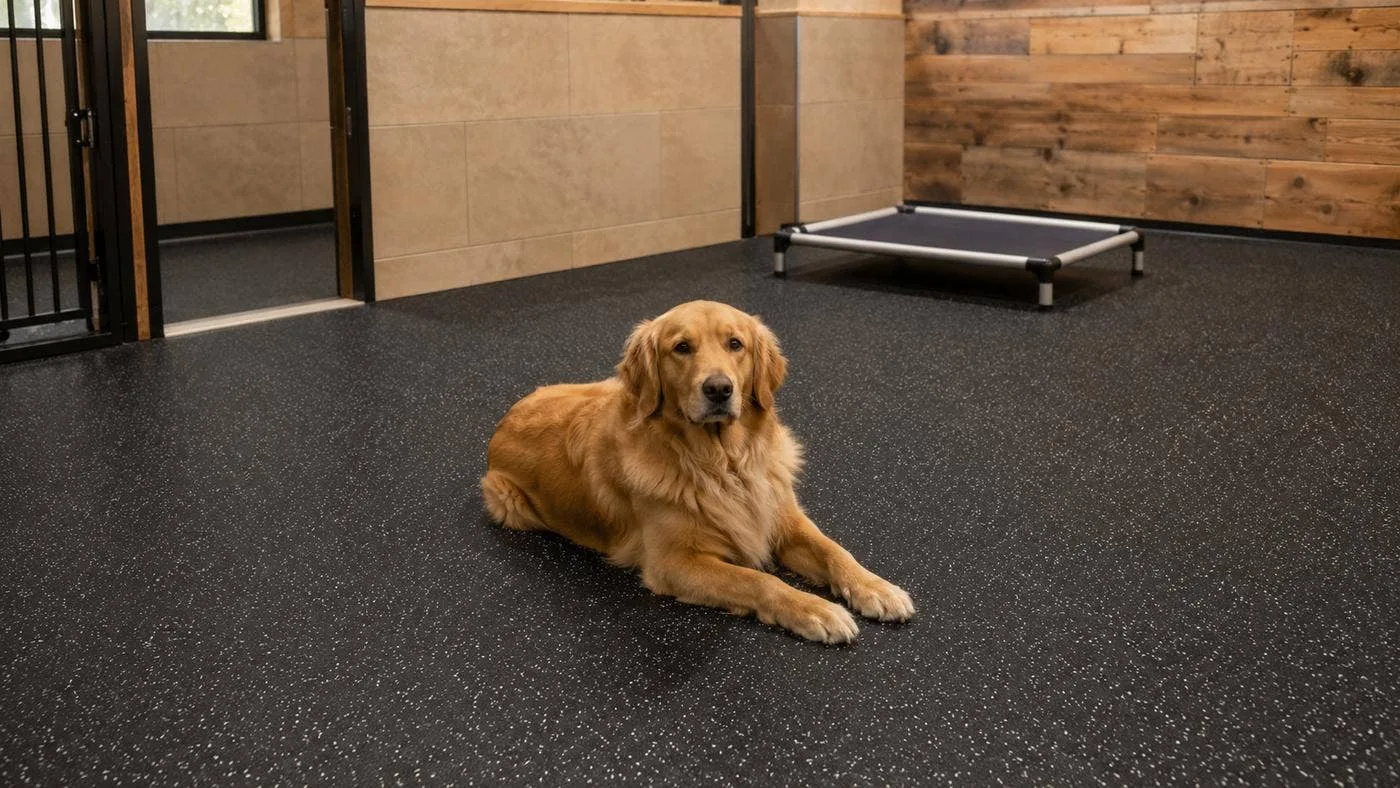
Standard recycled commercial rubber rolls still belong in the kennel, in the right zones. Sleep boxes, rest areas, staff aisles, and daycare play floors that get squeegee-and-mop cleanup rather than washdowns are where rubber's comfort, claw resistance, and sound absorption do their best work at the lowest cost per square foot.
The honest caveat, straight from our own buying guide: standard rubber rolls are semi-porous, so liquids can seep into the pores over time and get to the subfloor. In a dry zone that's a manageable maintenance fact. In a wet zone it's a failure mode. Keep them out of the runs unless you're committing to a full surface finish-and-sealer program, and even then, a sealed-surface product is the more durable answer.
Thickness: 8 mm. That's the sweet spot for a kennel: enough mass to take claw and impact abuse and to deaden barking, without the cost and the transition height of a gym-grade floor. Thinner than 6 mm gives up claw resistance and acoustic dampening. Going thicker means paying for impact protection a kennel doesn't need, so whatever height you land on, confirm a matching transition ramp profile before you order.
For breeders and small operators who started with residential rubber and are scaling up, our post on whether rubber mats are safe for dogs covers the pet-safety side.
Epoxy and Sealed Concrete: When Drainage Trumps Comfort
Is epoxy flooring good for dog kennels?
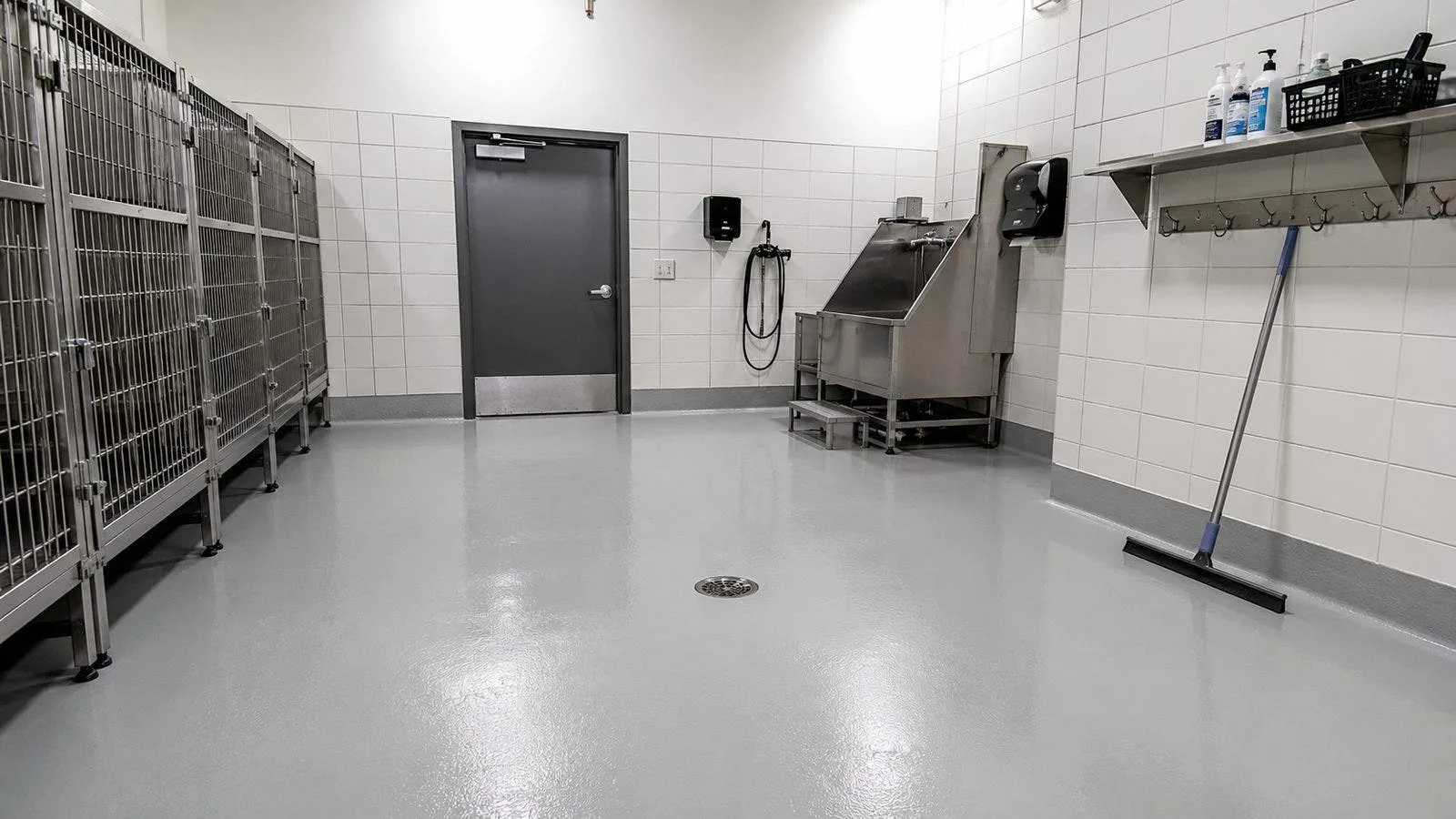
Epoxy is good for kennel back-of-house, where drainage runs the spec: runs with integrated floor drains, large boarding facilities at scale, animal shelter flooring for intake and quarantine runs, and breeder washdown rooms where the floor sees water more than animals at rest. It's the wrong choice anywhere animals rest for hours, because it's cold, hard, and reflects barking instead of absorbing it.
Where it wins is high-volume washdown with integrated drainage. At scale, the low ongoing cost and drain compatibility outweigh what you give up.
Where it loses:
- Anywhere animals lie down for 8 or more hours. Both epoxy and sealed concrete are cold and hard.
- Anywhere staff stand for hours. Both fatigue legs and knees.
- Anywhere noise reduction matters. Neither dampens barking; both reflect it.
Failure modes to plan around: coatings are a maintenance commitment. Plan for recoating on the manufacturer's schedule, and expect the highest wear at drain hardware, equipment legs, and door transitions. Sealed concrete loses its seal under repeated harsh-chemical cleaning. Ask for the specific product's recoat interval before you spec it.
Epoxy isn't our lead category for kennels, but we do sell it. Our commercial epoxy kits ship with primer and topcoat, so if drainage is running your spec, ask our commercial team to price a coating alongside the roll options. When a poured system or sealed concrete is genuinely the better fit, we'll say so. The goal is a facility that holds up for the long haul, not a floor forced into our favorite category.
Kennel Floor Drainage: The Design Decision Most Operators Underplan
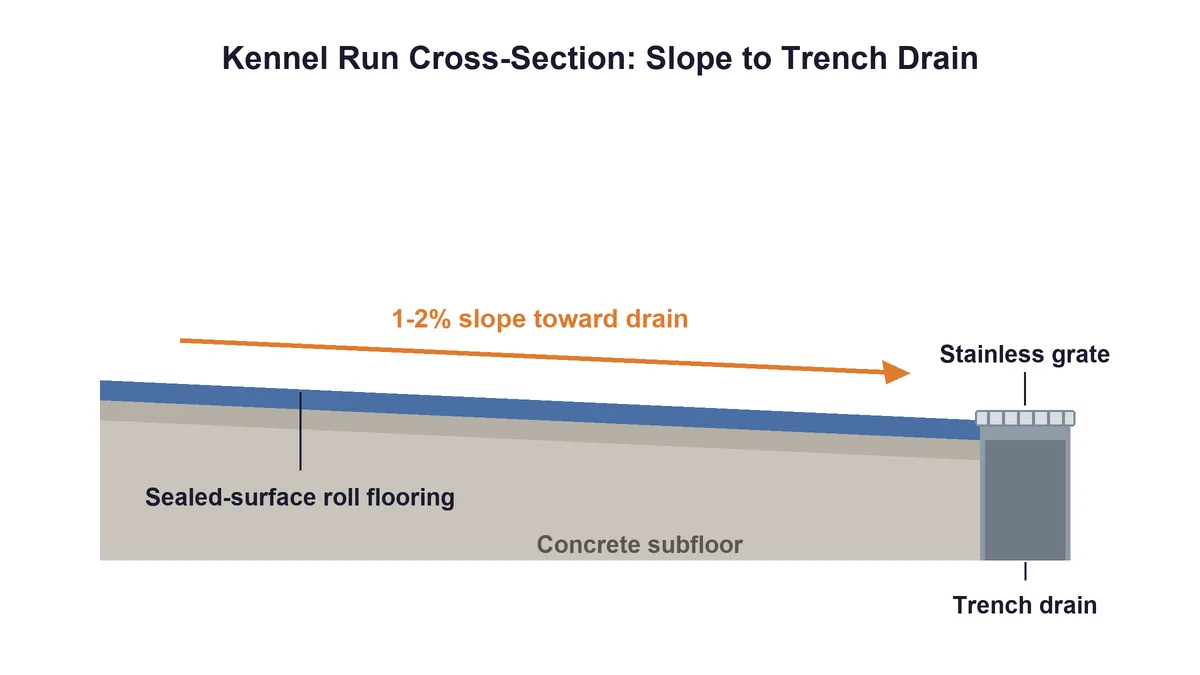
Drainage is the kennel design decision that drives everything else, and the flooring spec falls out of it.
Trench drains (continuous channels along the back of each run) are the operator favorite. The floor slopes 1 to 2% toward the drain. Sealed rolls work over a properly sloped substrate; sealed concrete works directly on the slope. Click-lock LVT is the wrong product on a slope.
Slope-to-drain (whole floor slopes to a center or corner drain) works with sealed concrete and epoxy. Rolled products can work, but the substrate has to be finished first and the roll sits over the slope, so add planning time for that sequence.
No integrated drainage is the reality in smaller breeder kennels, daycares, animal shelter retrofits, and vet boarding wings built into existing rooms. These spaces rely on squeegee-and-mop cleanup rather than washdowns, which is exactly where the two-zone system with standard rubber in rest areas makes sense. Skip the pressure washer entirely. There's nowhere for the water to go.
The common mistake is specifying washdown-rated flooring in a room without integrated drainage. The floor can take the water. The room has nowhere to put it. The result is standing water under the edges, seam degradation, and a smell that doesn't leave.
Drain hardware itself is not an FI product category. Stainless steel grates over PVC trench drains are the operator standard; plastic grates wear and warp under repeated washdown. Talk to your civil or plumbing contractor before locking the floor spec.
Comfort, Noise, and Long-Stay Considerations
Animals live in kennels. They sleep on the floor, and the flooring spec has to account for that. The same applies to dog daycare flooring, where dogs are on the floor all day even if they go home at night.
Comfort under prolonged occupancy. Concrete and epoxy are cold and hard, and animals lying on them 8 to 12 hours a day pay for it in comfort. Kennel operators consistently report better rest and less restlessness on resilient flooring. Rubber-based flooring at 7 to 8 mm is the meaningful upgrade, whether that's standard rubber in dry zones or a vinyl-surfaced rubber roll in wet ones.
Noise reduction. Barking on a hard floor compounds. Concrete amplifies and reflects; rubber dampens. The difference between a kennel with sealed concrete and one with rubber-based flooring is audible to anyone walking in the door.
Paw care. Operators in breeder production kennels, where dogs spend most of the day on one surface, tend to prefer a resilient floor for exactly this reason. Rubber has more give than concrete or a coating.
The vet boarding wing reality. If you're a vet adding a boarding wing to an existing clinic, the boarding wing floor should look like a kennel spec, not your exam room spec. Putting LVT in a boarding wing because it matched the exam rooms is how boarding-wing floors end up failing early. Our veterinary clinic flooring guide covers the rest of the clinic; come back here for the boarding wing.
Cleaning and Chemical Compatibility
Your cleaning protocol drives the floor spec, not the other way around. Most failures we see in kennel installs come from cleaning chemistry or water pressure the floor was never rated for.
Washdown compatibility. Twice-daily washdowns rule out standard rubber rolls, LVT, SPC, and carpet. In the washdown zone you want welded-seam vinyl-surfaced rubber rolls, 100% vinyl rolls, epoxy, or sealed concrete.
Day-to-day cleaning. For rubber-based products, the manufacturer-endorsed protocol is mild soap and warm water. Harsh chemicals can discolor rubber and degrade coatings over time. That includes bleach, solvent-based cleaners, and any disinfectant outside the manufacturer's guidance. If a specific disinfectant is non-negotiable in your protocol (parvo response, for example), send that product's name to the flooring manufacturer and get compatibility in writing before you sign the spec. Don't assume compatibility. Using a chemistry the manufacturer hasn't approved can void the warranty.
Disinfectant rotation. Many operators rotate disinfectants to prevent biofilm. The floor has to be compatible with every product in the rotation, not just the primary. Whichever surface you pick, clear the rotation with the manufacturer in writing, and send the full list rather than just the lead product.
One reality check: "we wash down every kennel run twice a day" rules out half the commercial flooring market by itself. Confirm your actual cleaning protocol with your facility manager before you spec.
Lead Time, Procurement, and Bulk-Order Realities
Commercial kennel builds run on tight timelines, and material lead time can be the deciding factor between two equally good specs.
- Where it ships from varies by product. Some items ship from our Tennessee warehouse. A lot of the catalog, including our rubber flooring rolls, drop ships direct from the manufacturer. Every product page lists its shipping speed.
- Made-to-order doesn't have to mean slow. Many made-to-order products offer a quick-ship option: pay a premium and it ships in 1 to 3 business days. Others run longer, up to about two weeks. It depends on the product, so check the page before you build a schedule around it.
- Custom-length cuts are made to order and carry a minimum length, either 10 or 15 feet depending on the product. The seam math still favors custom; plan the lead time into the build schedule.
- Free samples ship quickly and are available for most products. Get samples in front of the build team before the floor gets locked.
- Bulk projects should route through our Pro Command program, where pricing, consolidated freight, and staging can all be optimized for the order size.
FlooringInc has shipped flooring to federal, military, and educational institutions.
What Fails in Real Kennel Flooring Installs
Every kennel floor eventually shows wear. Knowing where each material fails first lets you spec around it.
- Standard rubber rolls: liquid penetration through the semi-porous surface in wet zones (preventable, keep them in dry zones). Edge curling without transition strips (preventable, spec the strips). Mid-run seam separation on fixed-length installs (preventable, custom-cut). Discoloration under harsh chemicals (manage with the cleaning protocol). A new-rubber smell during the first couple of weeks, which ventilation and routine soap-and-water cleaning normally take care of.
- Vinyl-surfaced and vinyl rolls: urine can stain lighter colors if messes sit, so darker colors and prompt cleanup manage it. Seams that aren't welded (where welding is specified) become the entry point for water.
- Epoxy: chipping at drains and door transitions, loss of slip texture over time, delamination if the substrate wasn't prepped.
- Sealed concrete: sealant breakdown under aggressive cleaning; cold and hard for animals at rest, so supplemental rubber in sleep zones is common.
- LVT and SPC: never the right call in a back-of-house kennel run. We mention them only to be explicit. Don't use them here.
Dog Kennel Flooring FAQ
What is the best flooring for a commercial dog kennel?
The best flooring for a commercial dog kennel is a two-zone system: sealed-surface rolls (vinyl-surfaced rubber with welded seams, or 100% vinyl rolls) in the wet runs and washdown areas, and 8 mm standard rubber rolls in the dry rest and sleep zones. Large facilities with trench drains and twice-daily washdowns add sealed concrete or epoxy in the back of house, usually alongside rubber in the rest zones rather than instead of it.
What flooring is most urine-resistant for kennels?
Non-porous surfaces are the most urine-resistant: 100% vinyl rolls, vinyl-surfaced rubber rolls, epoxy, and sealed concrete. Standard recycled rubber rolls are semi-porous, meaning liquids can seep into the pores over time, so they need a full finish-and-sealer program to serve in urine-exposed zones, and even sealed they trail the vinyl-surface options. How fast messes get cleaned up matters as much as the material.
Can you use rubber flooring in a commercial kennel?
Yes, in the right zones. Standard rubber rolls are the best dry-zone floor in the building, covering sleep boxes, rest areas, and staff aisles, for comfort, claw resistance, and noise. For wet runs and washdown zones, step up to a sealed-surface product: vinyl-surfaced rubber with heat-welded seams, or a 100% vinyl roll. Custom-cut lengths, transition strips at every edge, and flecked colors apply in every zone.
How long does commercial kennel flooring last?
Warranty terms are the most reliable guide. Impact Rolls Wood Series carries a 10-year warranty and Diamond Nitro carries a limited lifetime warranty, both assuming the floor is installed and cleaned to the manufacturer's spec. Standard rubber rolls in dry rest zones commonly outlast their wet-zone counterparts, simply because they see less water and less chemistry. The usual exception is a fixed-length roll in a long run: those tend to fail at the mid-run seam well before the material itself wears out, which is why custom-cut lengths are worth the lead time.
What's the best flooring for a kennel with floor drains?
Sealed concrete or epoxy is the best flooring for a kennel with integrated floor drains, because both sit directly on a sloped substrate and tolerate constant washdown. Sealed rolls can work over a properly sloped subfloor, with the substrate finished first. If comfort and noise reduction are priorities, rolls over the drained substrate keep both; if raw drainage flow is the priority, concrete or epoxy wins.
How do you clean dog kennel flooring without damaging it?
Clean dog kennel flooring with the chemistry the manufacturer endorses, which for rubber-based floors means mild soap and warm water. Get written compatibility for any disinfectant in your rotation before installation, follow dilution ratios, rinse rather than letting concentrated chemistry sit, and wash down only flooring rated for it. The floor that fails first is almost always the one cleaned with chemistry or pressure it wasn't rated for.
Is kennel flooring different from veterinary clinic flooring?
Yes, meaningfully. A vet clinic floor spec has to account for surgical infection control, exam room flexibility, and cart traffic in the front of house. A kennel floor spec leans into washdown tolerance, drainage, urine resistance, comfort under prolonged occupancy, and noise reduction. Materials that work in an exam room (LVT, SPC, sheet vinyl) often don't belong in a kennel run. For the clinic side, our veterinary clinic flooring guide walks the full spec by zone.
What to Do Next
Spec your kennel floor by the wear conditions it has to survive: sealed-surface rolls in the wet zones, standard rubber in the rest zones, and epoxy or sealed concrete where high-volume drainage runs the show. Plan custom-length cuts and transition strips into the order before lead time becomes the constraint.
If you're working a kennel, daycare, shelter, or breeder project right now, the fastest way to move is samples in front of your build team. We'll ship the relevant materials so the owner, the architect, and the kennel manager can put hands on the actual product before the spec gets signed.
Order free samples | Talk to our commercial team
You can also browse the full dog kennel flooring collection, which now carries the sealed-surface rolls and 8 mm rubber recommended above, to see current pricing and shipping speeds.