Best Flooring for a Veterinary Clinic: A Spec Guide by Zone
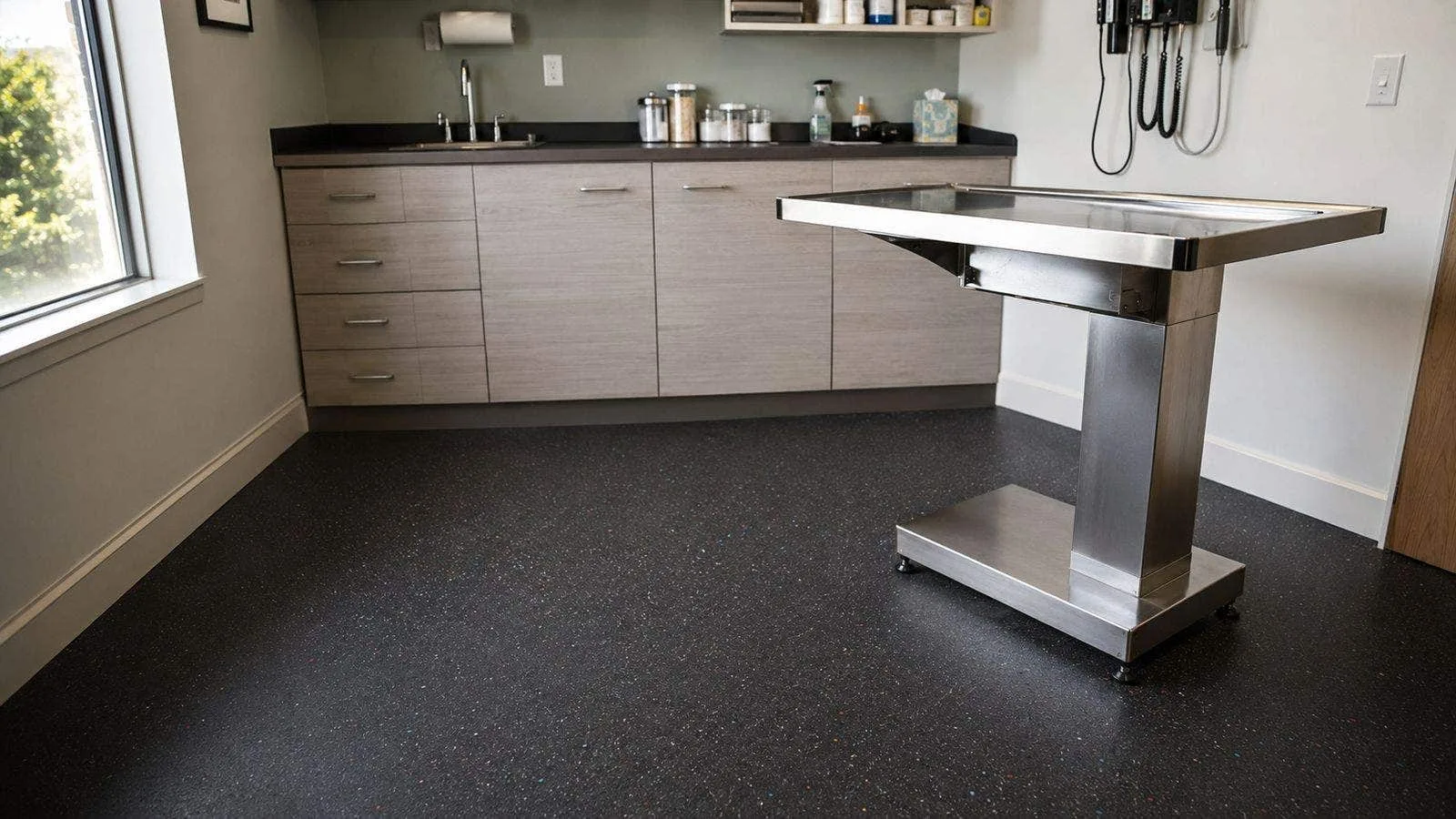
Most veterinary clinic flooring decisions get made under deadline pressure. The contractor needs a spec, the architect needs an answer, and the practice owner has eight other open items the same week. Two years later, the wrong call shows up as lifted seams in the treatment area, claw scratches in the exam room, or a urine smell in the kennel runs that nobody can scrub out.
The way to avoid that is to stop thinking about your clinic floor as one floor. A vet clinic isn't a single space. It's a stack of zones with very different jobs, and each zone wants a different material. Spec by zone, and the rest of the decision gets easier.
This guide walks through the constraints unique to animal-care facilities, gives you a zone-by-zone material recommendation matrix, then goes deeper on the four material categories that cover almost every vet build we see. At the end you'll have a defensible pick for every major area of the clinic and a way to get samples in front of your build team in days.
FlooringInc has been selling commercial flooring for over 18 years and works directly with the major manufacturers across rubber, vinyl, and specialty product categories. Animal-care facilities have always been part of that mix, and they remain one of the least-served verticals in the commercial flooring market. So we wrote this for the buyers who keep calling us with the same questions.
Why Vet Clinic Flooring Is Its Own Category
Vet flooring is not generic commercial flooring with extra disinfectant. It is a different category, and the people who treat it as a generic commercial spec almost always regret it within a few years.
Five constraints stack up in a vet clinic in ways they don't anywhere else:
- Cleanability. The floor will be mopped, sprayed, scrubbed, and disinfected multiple times a day, every day, for its entire service life.
- Urine and water resistance. Liquid exposure is constant. Not the occasional spill of an office building. Continuous, in the treatment area and the kennel, every single day.
- Slip resistance when wet. Wet floors and animals do not mix. Slip resistance has to be there when the floor is wet, not just when it's dry.
- Claw and impact resistance. Anxious dogs scratch. Heavy gurneys roll. Surgical instruments get dropped. The floor takes hits that most commercial spaces never see.
- Disinfectant tolerance. Quaternary ammonium compounds, accelerated hydrogen peroxide, bleach dilutions. Each one is chemistry the floor has to live with. The wrong floor and the wrong chemistry equals discoloration, surface degradation, or seam failure inside the warranty period.
Most commercial floors handle two or three of those constraints well. Few handle all five at the same time. That's why "by zone" beats "by material" as a specification framework. The lobby and the surgical suite have almost nothing in common in terms of what runs across the floor every day, so they shouldn't have the same floor.
The job is cleanability under stress. Cleanability isn't a feature in a vet clinic. It's the entire job description, and it gets measured five years in, not on day one.
The Clinic-Zone Matrix
The fastest way to specify vet flooring is to map each zone of the clinic to the material that handles its primary stressor best. Here's what we recommend for a typical small-animal practice or hospital. Larger boarding or specialty hospitals will have additional zones; the logic applies the same way.
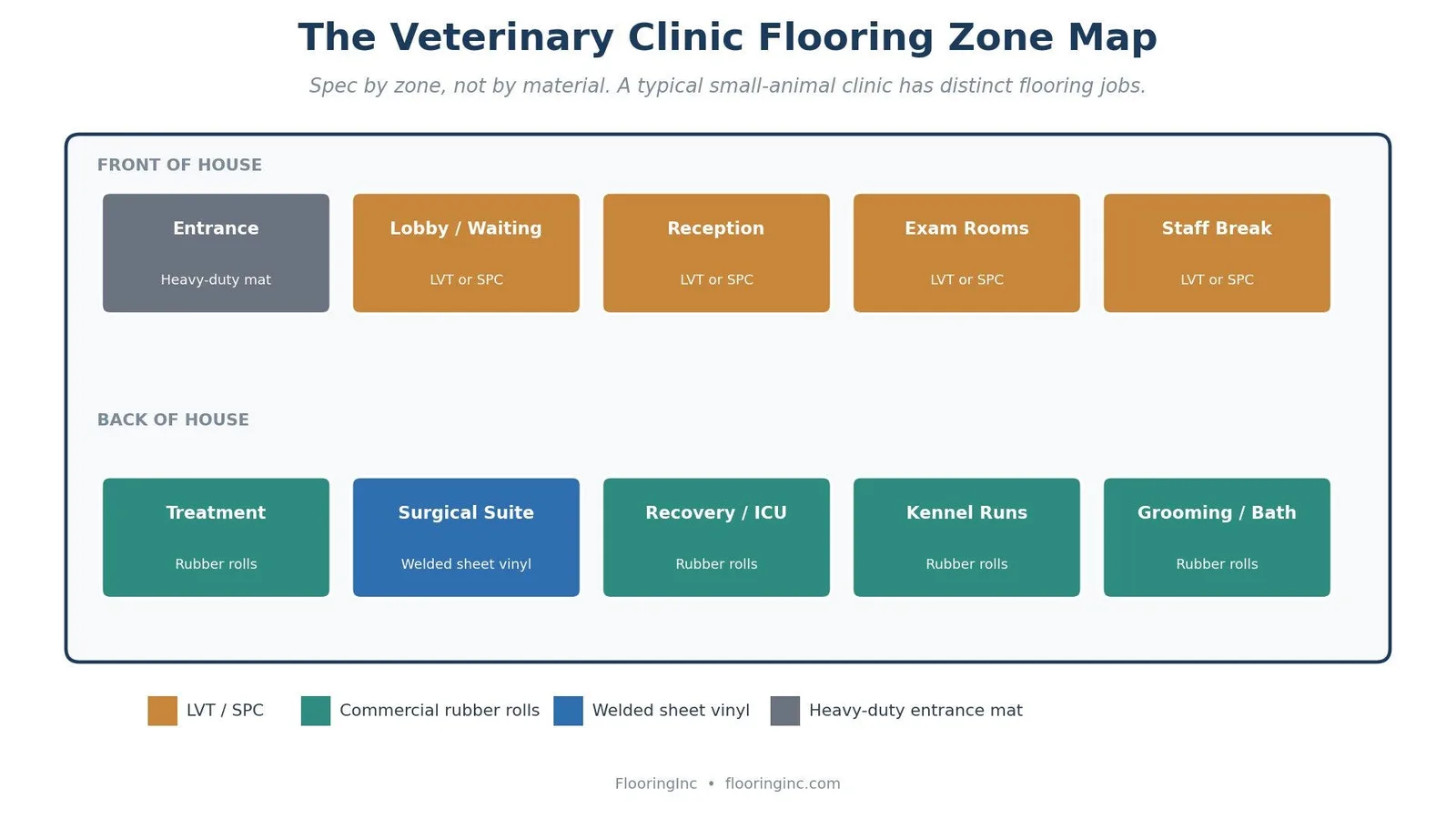
Spec by zone, not by material. A typical small-animal clinic has several distinct flooring jobs.
| Zone | Primary stressor | Recommended material | Acceptable backup |
|---|---|---|---|
| Entrance vestibule | Tracked-in dirt, water | Heavy-duty entrance mat over hard surface | Walk-off carpet tile |
| Lobby / waiting area | Cart loads, foot traffic, claw scratches, design feel | LVT or SPC (commercial wear layer) | Sheet vinyl |
| Reception / front desk | Wheeled chairs, foot traffic | LVT or SPC | Sheet vinyl |
| Exam rooms | Disinfectants, occasional urine, design flexibility | LVT or SPC (30 mil wear layer ideal) | Sheet vinyl |
| Treatment / "back of house" | Water, urine, dropped instruments, mopping | Sealed rubber plank or vinyl-topped rubber roll | Solid vinyl roll |
| Surgical suite | Aggressive disinfectants, infection control | Heat-welded seams and a coved base | Vinyl-topped rubber roll, welded |
| Recovery / ICU | Comfort under animals, cleanability | Sealed rubber plank | Vinyl sheet |
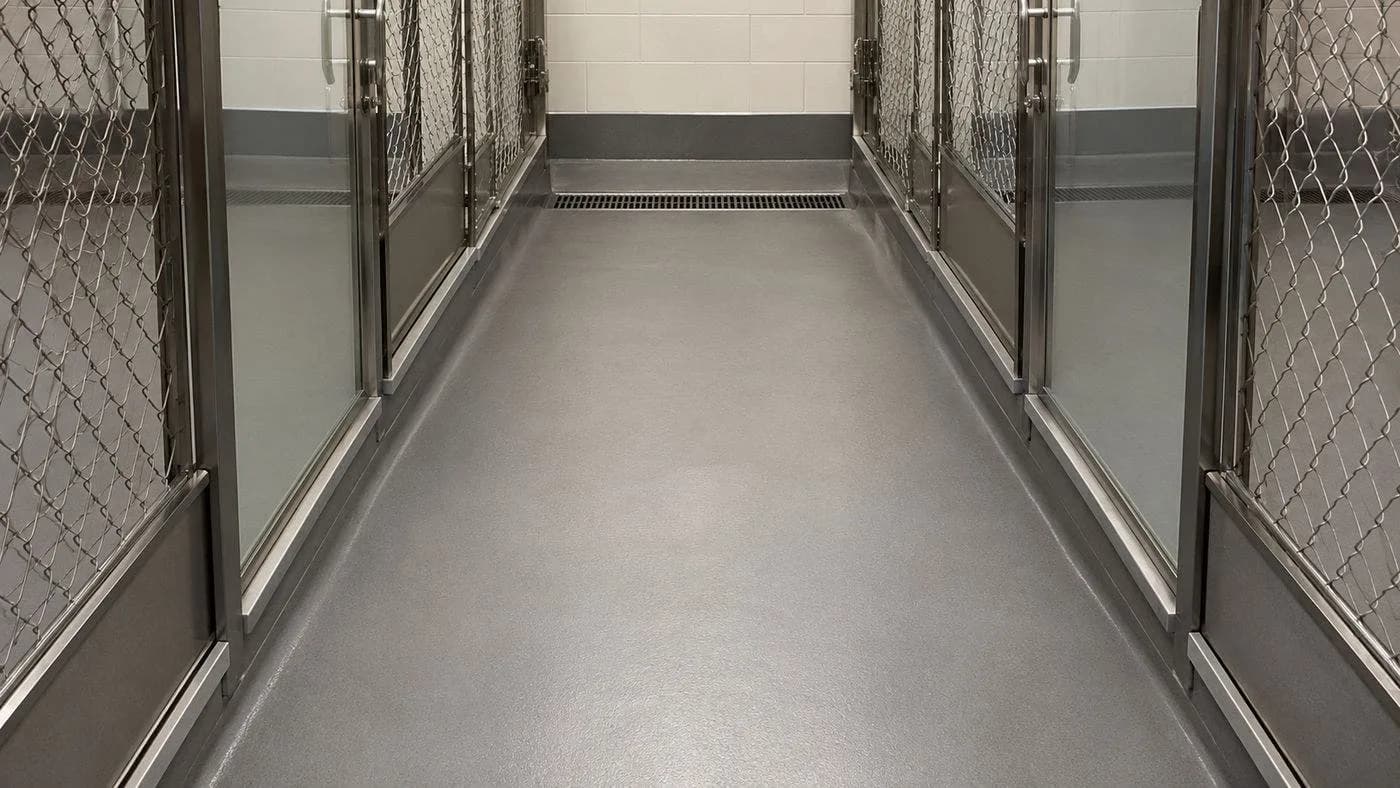
| Kennel runs / boarding | Power-washing, urine, claws, prolonged occupancy | Kennel flooring: drainage tile, kennel mats, turf | Sealed polished concrete or epoxy |
| Grooming / bath area | Constant water, slip resistance | Solid vinyl roll, coin pattern | Drainage tile in the tub surround |
| Staff break room | Foot traffic, comfort | LVT or SPC | Sheet vinyl |
This matrix is the spine of every successful vet flooring spec we see. Spec each zone for its actual job, then let the four material deep-dives below tell you how to spec well within the category.
Welded Seams in the Surgical Suite: The Spec to Hand Your Installer
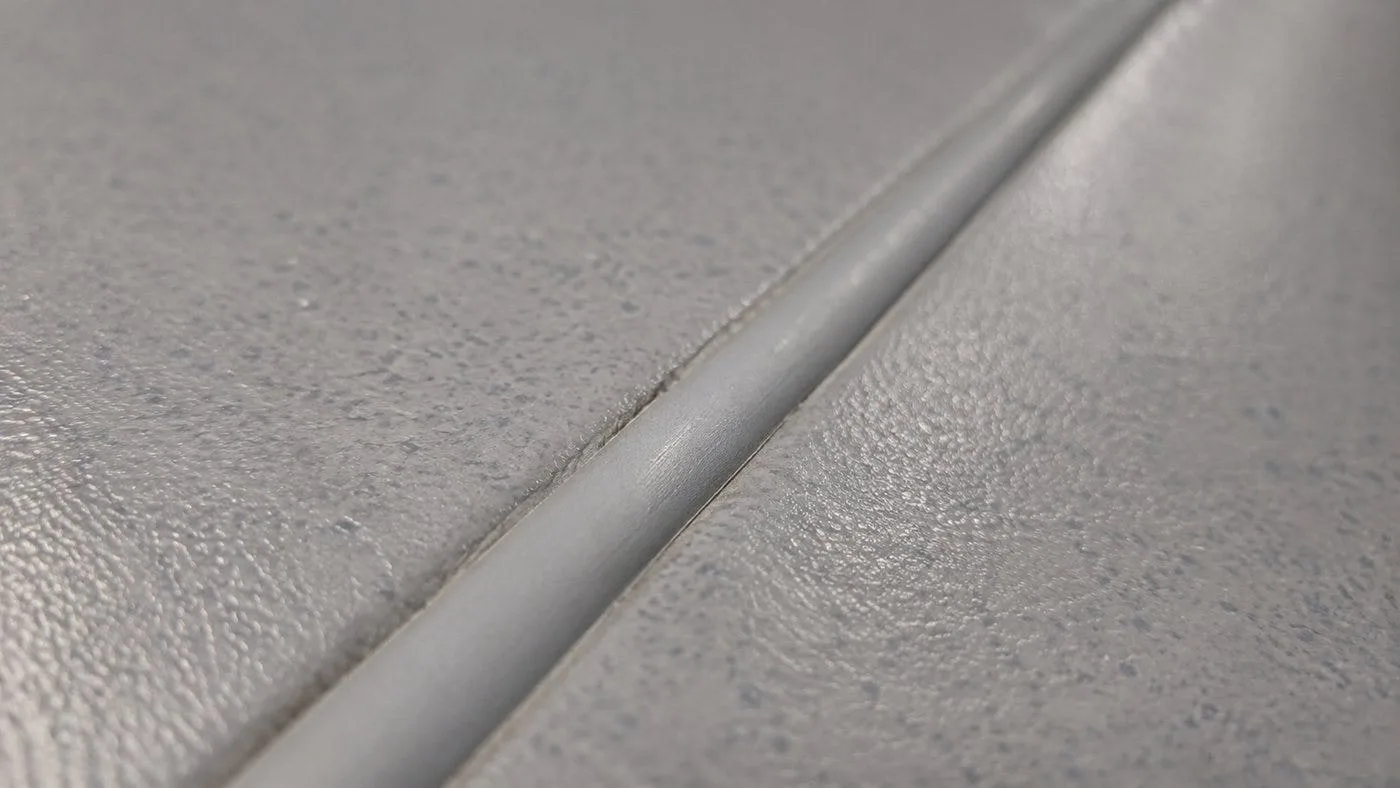
The welded seam: routed channel, PVC weld rod, heat-fused. Done right, the floor becomes one continuous surface.
For surgical, sterile prep, and any room where cleanability is the entire point, a heat-welded seam is the spec to hand your installer. It is the standard detail in human hospitals for the same reasons it works in vet surgical: no porous edges, no open seam for liquid to sit in, and a monolithic surface that can be coved 4 to 6 inches up the wall to eliminate the floor-to-wall joint.
What "welded" means: continuous sheet goods are rolled out, the seams between rolls are routed (mechanically grooved), and a PVC weld rod is heat-fused into the groove. Done correctly, the result is essentially a single continuous surface with no open seam where liquid and soil can collect.
What we can and can't supply here, plainly. Our sheet vinyl installs loose-lay, modified loose-lay, or full-spread glue. We publish no heat-weld specification for it and we sell no welding rod for it, so don't write our sheet vinyl into a welded-seam detail. The one welded-seam product we do sell is Impact Rolls in the Wood Series, a 2mm virgin vinyl wear surface over a 5mm rubber base whose install note reads "All seams must be heat welded," using matching welding thread sold separately. If your architect specified flash-coved homogeneous sheet for a true sterile suite, that is a specialty-installer purchase, and we'd rather tell you before you order than after.
Where a welded floor wins: surgical, sterile prep, isolation, any room where cleanability trumps everything else.
Where it doesn't fit:
- Lobby and reception. It reads "hospital," not "welcoming practice."
- Exam rooms. Less design flexibility than LVT, and replacement requires patching rather than swapping a single plank.
- Kennel runs. Claws can mark the surface over time, and the design intent (sterile, smooth) isn't what you want where animals live.
The real-world failure mode: poorly welded seams open within 2 to 3 years. This is almost always an installer problem, not a product problem. Specify a welded floor only when you have an installer who specializes in heat-welded flooring. If you don't, the warranty doesn't save you from the seam that lifts and the moisture that gets underneath it.
Lead-time reality: sheet vinyl in commercial colors and patterns is often made-to-order and can run multi-week lead times. Order samples early and lock the spec before your installation window narrows.
LVT and SPC: Exam Rooms, Lobby, and Reception
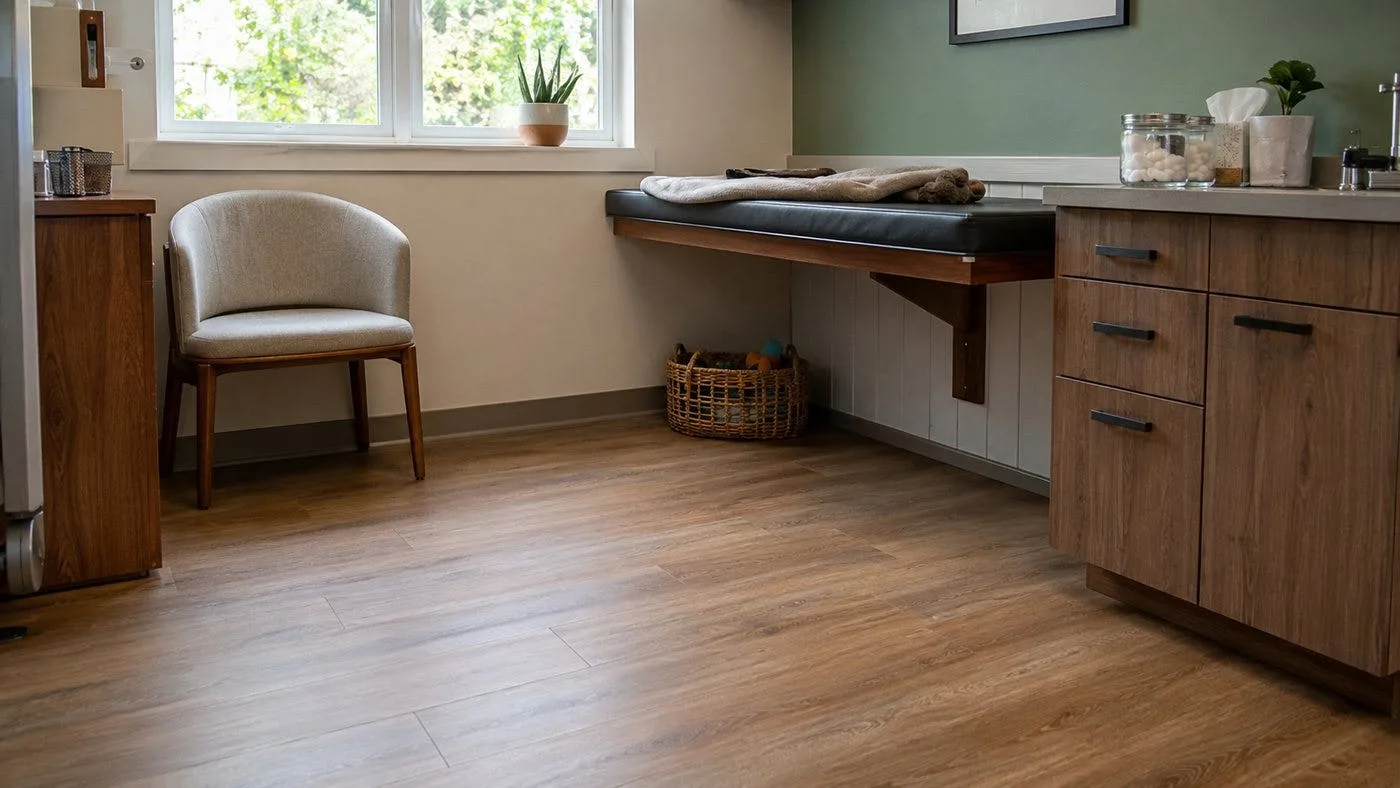
LVT in exam and reception zones gives a vet practice design flexibility without sacrificing cleanability.
For the largest square footage of most vet clinics (lobby, reception, exam rooms, staff areas), luxury vinyl plank flooring and SPC rigid-core flooring are the practical winners. They look like wood or stone, tolerate disinfectant cleaning, hold up to cart and gurney loads, and don't telegraph "hospital" to the pet owner walking in with an anxious dog.
SPC over WPC for clinical settings. SPC's rigid stone-plastic-composite core handles point loads (cart wheels, gurney casters, dropped objects) better than the softer WPC core. WPC is more comfortable underfoot but less durable for commercial traffic. For a vet clinic, default to SPC. (For the underlying core-material breakdown, our SPC vs WPC guide has the deep technical comparison.)
Wear-layer specs matter more than core thickness. This is the spec line most architects miss. Wear layer is the protective top film, measured in mils. For commercial vet traffic, 20 mil is the minimum we'd recommend. 30 mil is what we'd specify on a build we expected to last 15 years without replacement. Wear layers under 20 mil are residential-grade and tend to fall well short of a commercial 10 to 15 year service expectation in clinical settings. One catch worth knowing before you build a submittal package: wear layer isn't published for every product we carry, and it isn't a filter in our navigation yet, so ask us for the number and we'll pull it from the manufacturer.
Urine on LVT is manageable, if you spec well. The failure mode people worry about (urine wicking through the planks and rotting the subfloor) is associated with low-grade LVT that has poorly sealed click-lock seams or thin wear layers. Commercial-grade SPC with quality seam construction and a 20+ mil wear layer cleans up urine the same way it cleans up water: wipe and disinfect, move on. The seam tolerance is the load-bearing spec.
Why LVT in exam rooms beats sheet vinyl: a damaged plank pops out and gets replaced in 20 minutes. Damaged sheet vinyl requires a patch that's never invisible. Exam rooms see incidents (dropped equipment, anxious animals, the occasional surgical mishap). Plan for repair, not for perpetual perfection.
Sealed Rubber: Treatment, Recovery, and Grooming
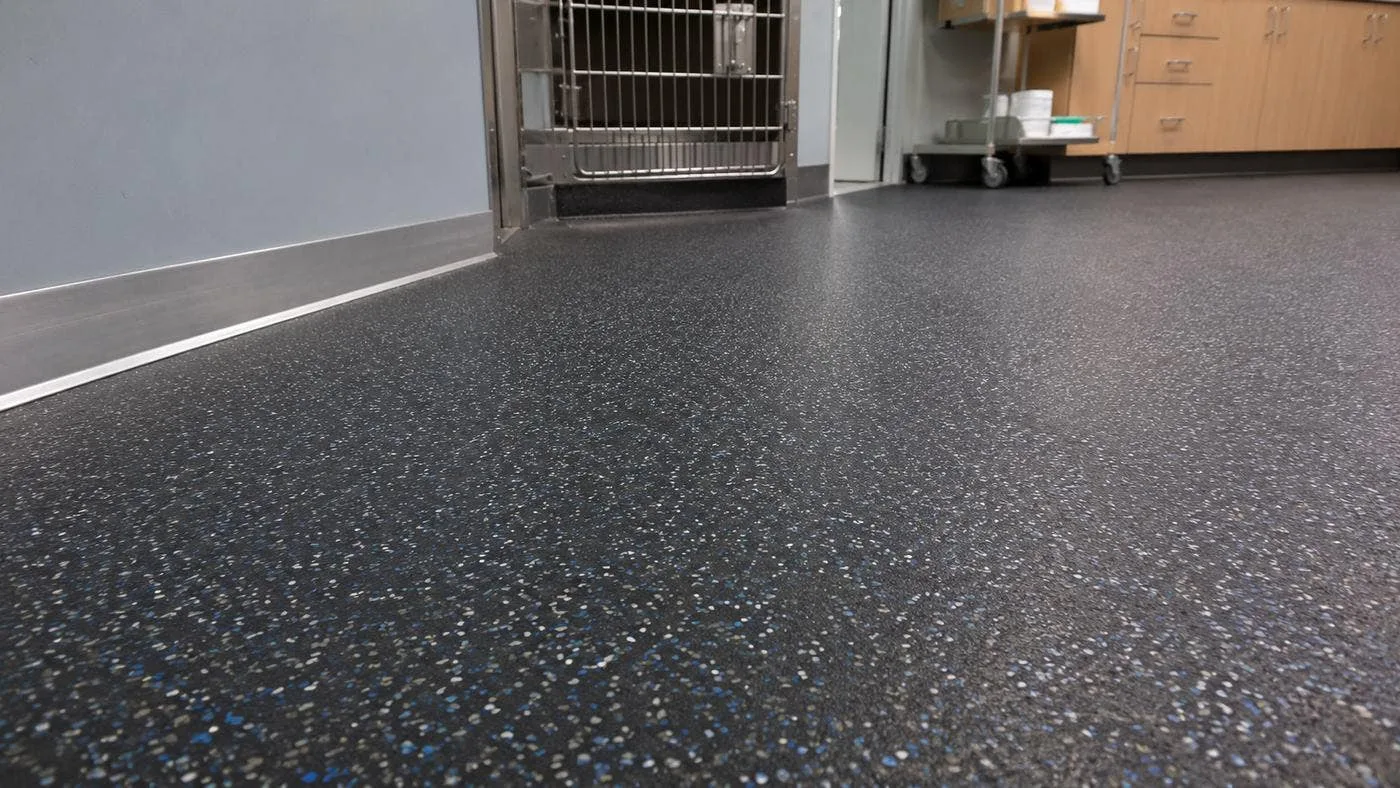
Flecked over solid, and a planned edge detail at every boundary: two specs that prevent the most common long-term failures.
Rubber is the most-recommended material in this vertical and the most often mis-specified. The question isn't rubber versus vinyl. It's whether the rubber surface is sealed, and that single property decides how a treatment room smells in year three.
Start with what our own documentation says. Our rubber flooring rolls buying guide describes our standard rolls as "semi-porous, so liquids can seep into the pores over time and get to the subfloor." Those rolls are non-vulcanized rubber recycled from truck and car tires. That construction is exactly why they make good gym flooring, and it's why we keep them out of clinical wet zones. The failure isn't wear. It's odor coming from under a floor that still looks fine.
For treatment, recovery, ICU, and grooming, spec one of two sealed formats instead.
Vulcanized rubber tile and plank. VersaRUBBER ELITE Rubber Tile Planks are double-vulcanized, glue-down, 1/4" thick, in a wood-look plank rather than a gym mat, with a 10-year warranty and no recycled content. The manufacturer describes the surface as "non-porous, hygienic, anti-fungal & antibacterial." That's their claim about their product and we quote it as theirs, not as an infection-control program. 1/2" Premium Gym Floor Tiles are vulcanized as well and use the word a clinic buyer actually needs: non-absorbent. At 1/2" they're the pick for the room where instruments and equipment get dropped.
Vinyl-topped rubber rolls. Impact Rolls in the Wood Series put a 2mm virgin vinyl wear surface over a 5mm rubber base, 6 feet wide, with free custom cutting from 25 to 45 feet. The vinyl layer does the sealing and the rubber underneath does the impact and acoustic work. Read the install note before you buy: "All seams must be heat welded," using the matching welding thread, which is sold separately and is a professional job. It's the only product we sell built to become a monolithic floor, which is why it also shows up in the surgical row of the matrix above.
Thickness for vet use: 8 to 10 mm (5/16" to 3/8") in rolled and tiled goods, or 1/4" in a dense vulcanized plank. Past 12 mm is overkill outside heavy kennel runs where staff stand all day. Under 6 mm you give up the impact tolerance for dropped instruments and the acoustic dampening that keeps a treatment area with six conversations in it from wearing everyone out. Density matters more than raw thickness here, and a 1/4" double-vulcanized plank beats a thicker crumb-bound roll on both point loads and cleanability.
Custom-length rolls beat fixed-length in treatment bays and corridors. Custom cutting carries a 15-foot minimum in whole-foot increments, so a typical 8 to 12 foot exam room can't use one at all — spec tile, plank, or a fixed-size pre-cut roll there. Where the room is long enough, a single cut length removes the mid-room seam, which is the most common long-term failure point in any rolled install.
Flecked over solid for any zone with hair, water spots, or claw scuffs. A flecked or color-mixed tile hides the realities of daily clinic life. Solid black and solid gray look sharp on day one and show everything on day 365. Most vet buyers who go solid wish they'd gone flecked, and we get those calls too.
Plan the edge before the install, not after. Rubber expands and contracts with temperature, and without a defined termination the material creeps, edges curl, and inside 18 months you have lifted edges that catch mop buckets and trap water underneath. Spec the edge treatment up front. Our rubber floor ramps cover 4–6mm and 7–9mm material only; above 9mm we don't stock a ramp, so terminate into a coved wall base instead. A 2.5" or 6" rubber coved base is the standard detail in medical build-outs anyway, and it closes the floor-to-wall joint while it's at it.
One conflict worth naming here rather than burying in a care tab. Our own rubber care guidance advises against solvent and oil-based cleaners and names Lysol among them. Lysol is a mainstream clinic disinfectant. If your daily protocol is built on it, a sealed vinyl surface is the better fit for that room than any rubber, and we'd rather say that than sell you the return.
For deeper roll spec content, our Expert's Guide to Rubber Flooring Rolls for Gyms covers thickness, weight, and roll-size logic, and our commercial gym flooring guide has the broader commercial rubber context. Both are written for gyms, which is the point: the gym is where the recycled roll belongs. When you're ready to price the sealed products room by room, they're merchandised by clinical zone on our veterinary clinic flooring page. (Pet owners who want the residential-side context can check our take on whether rubber mats are safe for dogs.)
Epoxy and Polished Concrete: The Right Answer in a Narrow Window
Epoxy coatings and polished concrete are real options for vet flooring, but in a narrow window. They work for back-of-house kennel and run areas where drainage and pressure-washing matter more than acoustic comfort or paw cushioning.
Where they fit: large boarding facilities, indoor runs with floor drains, high-volume hospital back-of-house. The combination of low ongoing maintenance cost, drainage compatibility, and ability to power-wash makes the math work at scale.
Where they don't fit:
- Anywhere animals lie down for extended periods (hard, cold).
- Anywhere staff stand for hours (fatiguing on knees and feet).
- Exam rooms and front-of-house (the clinical feel and limited design flexibility hurts the practice's brand).
The slip-resistance tradeoff matters. Epoxy can be specified with grit additives for wet-slip resistance. The same grit additive makes the floor harder to clean. You can't have a smooth easy-to-mop surface and aggressive slip resistance in the same coating; pick which one matters more for the zone.
One more thing an epoxy quote will bring up and a modular quote won't: substrate prep. A resinous coating bonds chemically to the slab, so the slab has to be qualified first with moisture testing, manufacturer sign-off, and mechanical profiling, then given cure time. Tile, plank, and roll goods skip that sequence. You confirm the slab is flat and clean, and start laying.
FlooringInc does not sell epoxy coatings. We'll tell you when it's the right answer because the goal is your facility holding up for 15 years, not pushing you into our product when a different category fits better.
Cleaning, Disinfectant Compatibility, and Lead Time
The floor you spec has to survive the chemistry you clean with every day. Most failures we see in vet clinics aren't from the animals; they're from disinfectant chemistry the floor was never rated for.
General compatibility guidance. No product page on our site publishes disinfectant compatibility data, so treat a blanket compatibility claim with suspicion no matter who makes it. Confirm with the manufacturer for the specific product and the protocol you'll run day to day, and if the statement isn't in the product literature, send us the SKU and we'll go get it. Here's a conflict we'd rather name than bury: our own rubber care guidance advises against solvent and oil-based cleaners and names Lysol among them, and Lysol is a mainstream clinic disinfectant. If your protocol depends on it, sealed vinyl is the better surface for that room than rubber. The high-level pattern most spec sheets show:
- Quaternary ammonium compounds (the workhorse of vet disinfection) are commonly compatible with commercial sheet vinyl, LVT, SPC, and rubber when used at recommended dilutions.
- Accelerated hydrogen peroxide is generally gentler on flooring materials than quats and has been gaining ground in vet practices.
- Repeated bleach exposure is commonly cited by manufacturers as a leading cause of rubber discoloration and accelerated wear-layer breakdown on some LVT products. If your protocol requires bleach, specify the floor with that protocol in mind, not after.
- Power washing is a kennel-run tool, not an interior one. It belongs over a sloped, drained slab with drainage tile on top. Glue-down planks, floating planks, and taped rolls aren't built for it, because you're driving water into seams and under edges at pressure. Our own rubber care copy warns that water seeping into seams causes the rubber to lift and curl at the edges.
Lead times: commercial rubber rolls and most commercial LVT/SPC ship from inventory at our Tennessee warehouse when the item is in stock. Custom-length roll cuts take longer, and sheet vinyl in commercial patterns is more often made-to-order. We don't publish day counts, so ask your rep for the current window on the exact SKU before you commit to an installation date. Order samples the day you start the spec rather than the week you lock it.
FlooringInc has fulfilled commercial orders for federal, military, and educational customers. Procurement-grade vendor experience matters when you're submitting a commercial purchase order, not a personal credit card.
What Fails in Real Vet Installs
Every flooring material in a vet clinic eventually shows wear. Knowing where each one fails first lets you spec around it.
- Recycled rubber rolls: liquid reaching the subfloor. Our buying guide calls them semi-porous, and in an enclosed room that shows up as retained odor rather than visible damage. This is the reason we don't spec them into sealed clinical zones at all.
- Sealed rubber tile and plank: edge curling without a planned termination (preventable, spec the wall base or ramp up front). Off-gassing during the first few weeks after install (typically resolves with ventilation; if it lingers past the first month or two, something is wrong with the product or the install and the supplier should investigate). Discoloration under regular bleach exposure (talk to the manufacturer if your protocol requires bleach).
- LVT and SPC: seam moisture wicking on low-grade products with thin wear layers (spec commercial-grade with 20+ mil wear layer and quality click-lock construction; this stops being a problem). Click-lock separation under repeated heavy disinfectant flooding (rare on commercial-grade SPC; non-issue at the spec we recommend).
- Welded floors: failed welds. This is an installer issue the vast majority of the time, not a material issue. The fix is finding an installer who specializes in heat welding. If you can't, choose a different category for that zone.
- Epoxy: chipping near drains, around equipment legs, and at door transitions. The maintenance schedule isn't optional; build it into your facility plan from day one.
FAQ
What is the best flooring for a veterinary clinic?
There isn't one best floor. The right answer depends on the zone. For most clinics: sealed rubber plank or a vinyl-topped rubber roll for treatment and recovery, a solid vinyl roll for grooming and bath, commercial-grade LVT or SPC for lobby, reception, and exam rooms, and a heat-welded surface for the surgical suite. Leave the recycled rubber roll out of any room that has to be sealed.
Is rubber or LVT better for a vet clinic?
Both, in different zones. Sealed rubber wins where there's constant water, dropped weight or instruments, and prolonged animal occupancy. LVT and SPC win where design flexibility, foot traffic, and easier plank-level replacement matter more. The mistake is forcing one material across the entire build.
What flooring is most urine-resistant?
It depends on which product, and the industry gets this wrong constantly. Our standard recycled rubber rolls are non-vulcanized recycled tire rubber, and our own buying guide calls them "semi-porous, so liquids can seep into the pores." The sealed products are a different story: VersaRUBBER ELITE is described by its manufacturer as non-porous, Impact Rolls Wood Series puts solid vinyl over the rubber, and solid vinyl rolls have no absorbent layer at all. With LVT and SPC the spec decides it, and commercial-grade products with sealed click-lock seams and 20+ mil wear layers handle urine the same way they handle water. The strongest predictors of long-term performance are how fast the floor gets cleaned and how the seams are built, not the material category alone.
Can you use epoxy floors in a vet clinic?
Yes, in the right zones. Epoxy and polished concrete are good fits for kennel back-of-house, indoor runs with floor drains, and large hospital back-of-house. They are wrong choices for exam rooms, lobby, and any zone where animals lie down or staff stand for hours.
How do I disinfect vet clinic floors without damaging them?
Specify the cleaning chemistry before the floor, not after. Confirm material compatibility with the manufacturer for the specific disinfectant you'll use day to day. Rotate disinfectants when your protocol allows, follow dilution ratios exactly, and rinse residue rather than letting concentrated chemistry sit on the surface. The floor that fails first is almost always the one cleaned with chemistry it wasn't rated for.
What to Do Next
Spec by zone, not by material. Prioritize long-term failure modes over the day-one look. Get samples in front of your build team before the architect locks the floor plan.
If you already know which rooms you're fixing, every product named in this guide is merchandised by clinical zone on our veterinary clinic flooring page, at published prices you can buy against today rather than quote-request.
If you're working a vet clinic project right now, the fastest way to move is a commercial sample pack sent to your build team. We'll ship samples of the relevant materials for each zone of your clinic so the architect, the practice manager, and the partner DVM can put hands on the actual product before the spec gets signed.
Request a commercial sample pack for your vet clinic project
Or order free samples of any individual product you want to evaluate on your own desk first.