
What Trade Show Flooring Costs: Shipping, Drayage, and the Cheap Way In
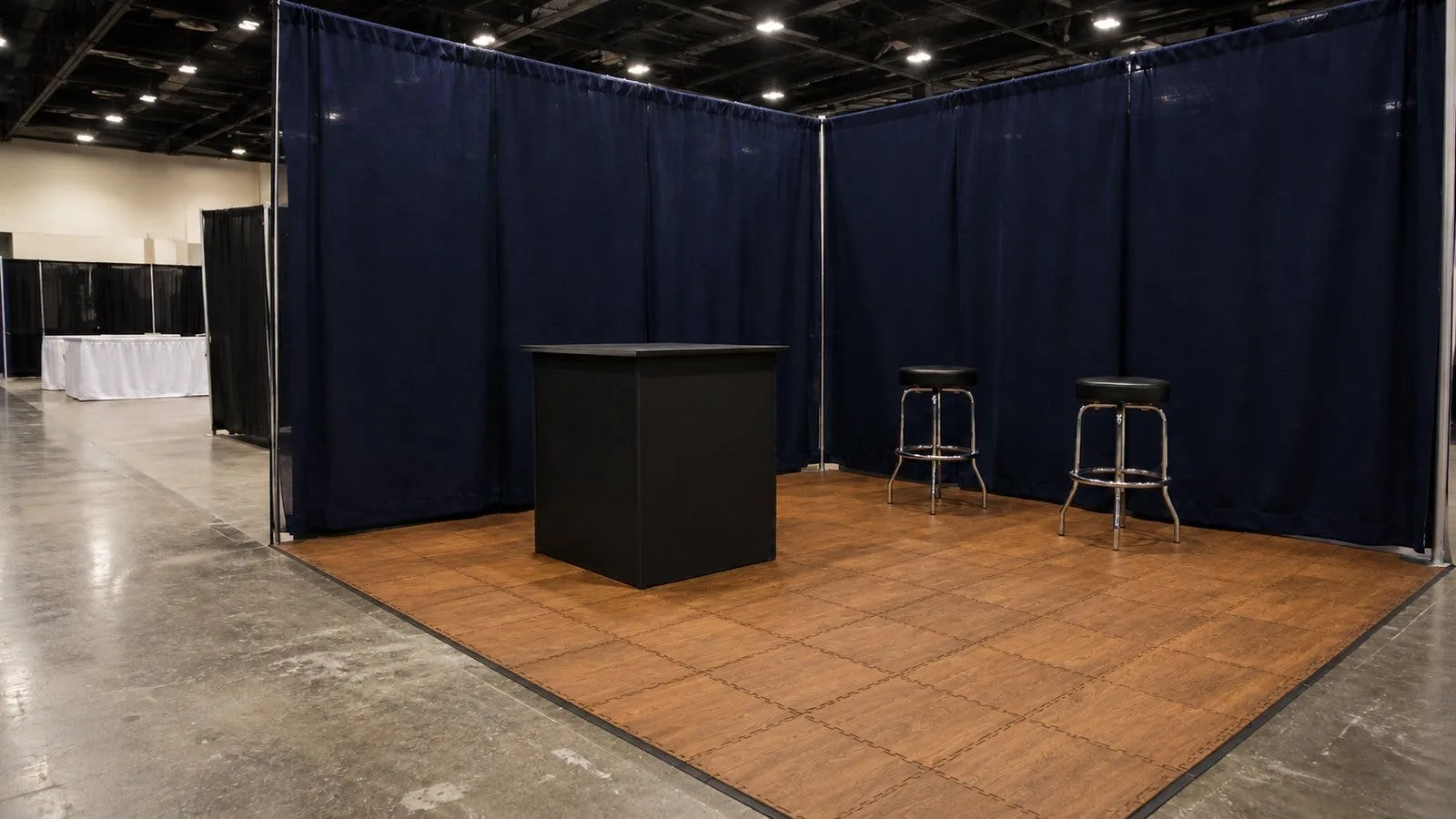
Most advice on trade show flooring cost stops at the sticker price. I've been selling flooring since 2007, and the sticker price is usually the smaller half of what an exhibitor actually pays.
The bigger half is getting the floor from wherever it lives to the middle of your booth. That can cost you nothing, or it can cost more than the floor did. Which one you get has almost nothing to do with whether you prefer foam or rubber.
Two separate companies bill you to move that floor. The carrier brings it to the building. Then the show's general contractor charges again to walk it from the dock to your booth. Miss the second one in your budget and the invoice will surprise you.
If you're still picking a material on looks and feel, start with our best trade show flooring guide. This one is about the money.
The short version: tiles for a 10x10 booth run $119 to $349, and our complete 10x10 kits are $179.99 to $289.49. Getting a foam kit to the show costs another $115 to $130. Getting that same kit to your hotel and carrying it in yourself costs $30 to $45. Palletized commercial rubber runs $730 to $1,230 delivered.
What the Flooring Itself Costs
This is the number every other cost guide leads with, and it's the part of your budget that varies least.
Loose tiles for a 10x10 booth run $119 to $349, or roughly $1.14 to $3.49 per square foot depending on material. Our complete 10x10 kits, which include 25 tiles and a carrying case, are:
- Eco-Soft Trade Show Kit at $179.99
- Soft Wood Trade Show Kit at $189.99
- Premium Foam Trade Show Kit at $289.49
A 10x20 takes two kits. A 20x20 takes four.
Now the part almost nobody prices for you.
The Two Bills
Every dollar past the sticker price is either transportation or material handling. Different companies, different invoices, different rules.
Transportation is FedEx, UPS, or a freight carrier bringing your floor to the venue. You pick this vendor and you can shop it.
Material handling, usually called drayage, is the show's general contractor receiving your shipment, moving it to your booth, storing your empty cases during the show, bringing them back, and loading you out. You don't pick this vendor. It's whoever the show hired, most often Freeman or GES at large US shows with regional contractors like Shepard, Vista, and Rosemont Exposition Services covering the rest. The rate is printed in the exhibitor services manual.
Stacked together for a 10x10 foam kit, the four realistic delivery paths run from nothing to about $130. For palletized commercial rubber they run $730 to $1,230.
| How the floor arrives | Carrier charges | Show charges | All-in (10x10 foam kit) |
|---|---|---|---|
| You drive it and hand-carry it in | $0 | $0 | $0 |
| Parcel to your hotel, you carry it in | $30 – $45 per box | $0 plus a hotel receiving fee | $40 – $80 |
| Parcel to the show | $30 – $45 per box | $85 minimum | $115 – $130 |
| Palletized commercial rubber | $270 – $450 LTL | $460 – $780 | $730 – $1,230 |
Look at the top three rows. The floor is identical. What changes is who carried it the last two hundred feet.
What the Carrier Charges
This part you control, and most exhibitors overpay because they never ask.
A 10x10 foam or carpet kit splits into one to two cartons of roughly 25 pounds each. On a negotiated FedEx or UPS account that's about $30 to $45 per box cross-country. Without an account, at retail counter rates, budget two to three times that. If your company has a shipping contract, get marketing added to it before your next show. That one phone call is worth more than any flooring decision in this post.
Commercial rubber is a different animal. Sport-Lock for a 10x10 runs 320 pounds, which is a pallet, which means LTL freight rather than parcel. LTL is less-than-truckload, where your pallet shares a trailer with other companies' freight. Budget $270 to $450 to get that pallet across the country.
Before the show charges a cent, a 10x10 of commercial rubber costs six to ten times more than a 10x10 of foam just to reach the building. The difference in what the two floors cost to buy never comes close to that.
What Trade Show Drayage Costs
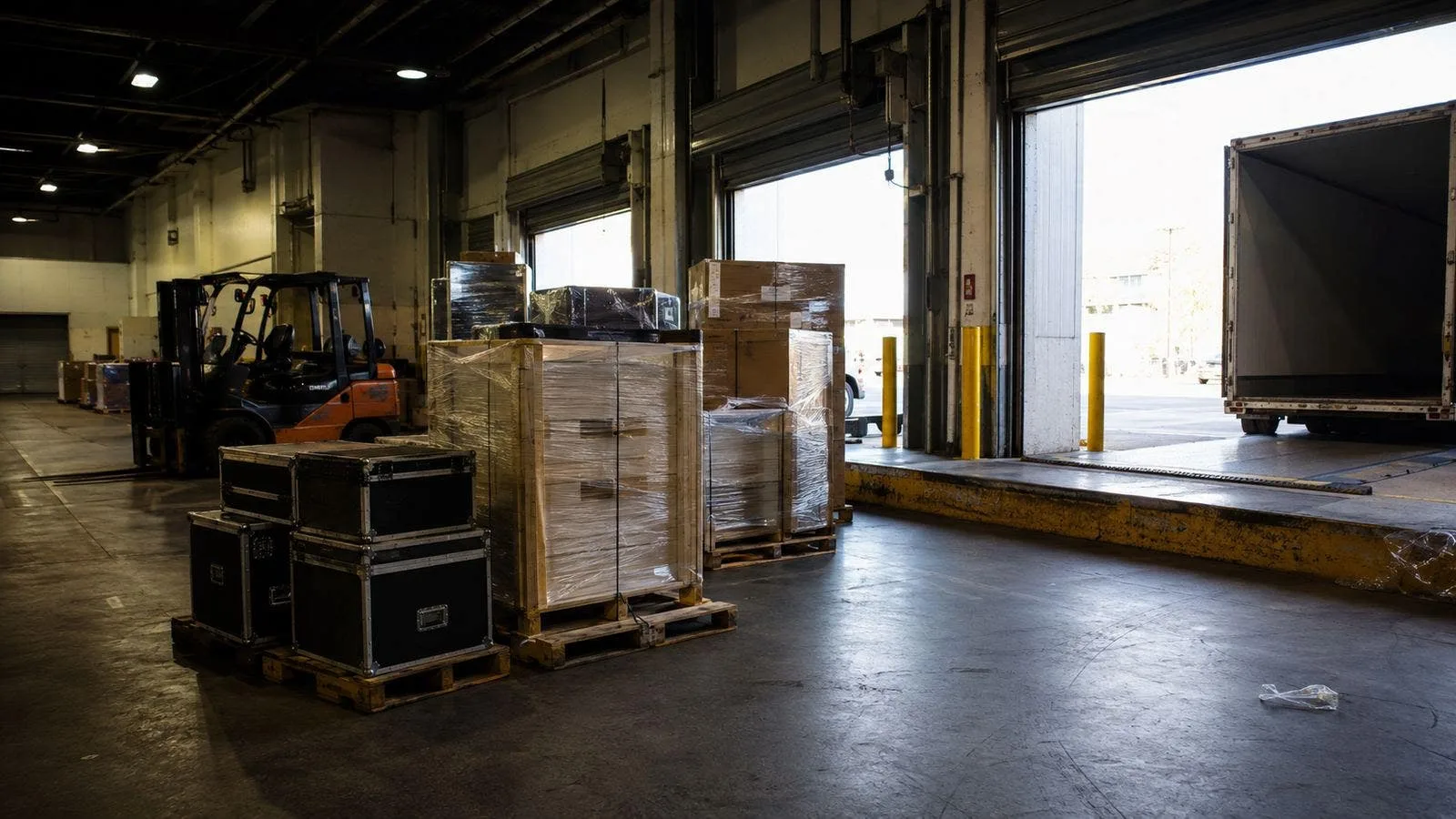
This is the bill people forget, and it's charged round trip.
Contractors publish two rate structures, and which one you land in depends entirely on how your floor shows up at the dock.
If it arrives by FedEx, UPS, or DHL
Parcel shipments bill under a Small Package rate, charged per carton instead of per pound. One 2025 show published $35 for the first carton and $10 for each additional, with an $85 minimum. In that show's own words, one through six boxes all bill $85.
Because of that minimum, a foam kit arriving in two cartons pays the same $85 as one arriving in four, or in six. You'd have to ship more than six boxes before the per-carton rate beats the minimum at all.
If it arrives crated or palletized
Now you're on the per-hundredweight rate. A hundredweight, abbreviated CWT on every rate sheet you'll see, is 100 pounds, so a rate published as $150 per CWT is $1.50 per pound.
Published 2024 to 2026 US rate sheets run roughly $1.15 to $1.95 per pound, or $115 to $195 per CWT, round trip, and they move more than you'd expect. Rosemont Exposition Services published $115 per CWT for direct-to-show-site delivery at a May 2026 Illinois show. Vista Convention Services published $194.25 for a June 2026 Baltimore show. Same service, one month apart, 69 percent apart on price. There is no national rate.
Three mechanics decide your bill more than the headline rate.
The minimum. Many contractors set a 200 pound floor, though we found 100 pound minimums and flat $75-per-shipment minimums too. Under a 200 pound minimum, a 40 pound floor and a 190 pound floor cost exactly the same.
Rounding, per piece. Weight rounds up to the next hundred pounds on every piece. A 285 pound crate bills as 300. Separate pieces each carry their own minimum, which is why consolidating matters.
Loose freight costs more than crated freight. Anything arriving without a crate or pallet gets surcharged, and across the sheets we pulled it ran 25 to 57 percent above the crated rate. Rolled carpet is named specifically: Freeman classifies loose carpet and pad as special handling at a 50 percent premium, citing the extra labor to unload it. A cased tile kit is crated freight. A carpet roll usually isn't.
Here's the math on a real product. A 10x10 of 3/8" Sport-Lock weighs 320 pounds, which rounds up to 400 for billing, and 400 pounds at $1.15 to $1.95 is $460 to $780 in material handling. Add the $270 to $450 in LTL freight and that floor has cost $730 to $1,230 to deliver before anyone stands on it.
The advance warehouse discount is mostly a myth. Nearly every trade show shipping guide claims that shipping to the show's advance warehouse instead of direct to show site saves 15 to 30 percent. The advance warehouse is a staging facility the contractor runs near the venue, where you ship weeks ahead instead of timing a truck to hit the dock on the right day. We checked four current US exhibitor kits dated 2024 through 2026 and none of them discounted it. Three priced advance warehouse and direct-to-show-site identically. Rosemont priced advance at $145 per CWT against $115 direct, 26 percent higher. EXHIBITOR magazine's industry labor rates survey found the same pattern, with advance warehouse averaging $102.88 per CWT against $96.96 direct. Shipping early buys you certainty that your freight arrives. It does not buy a lower rate.
What Each Floor Costs, All In
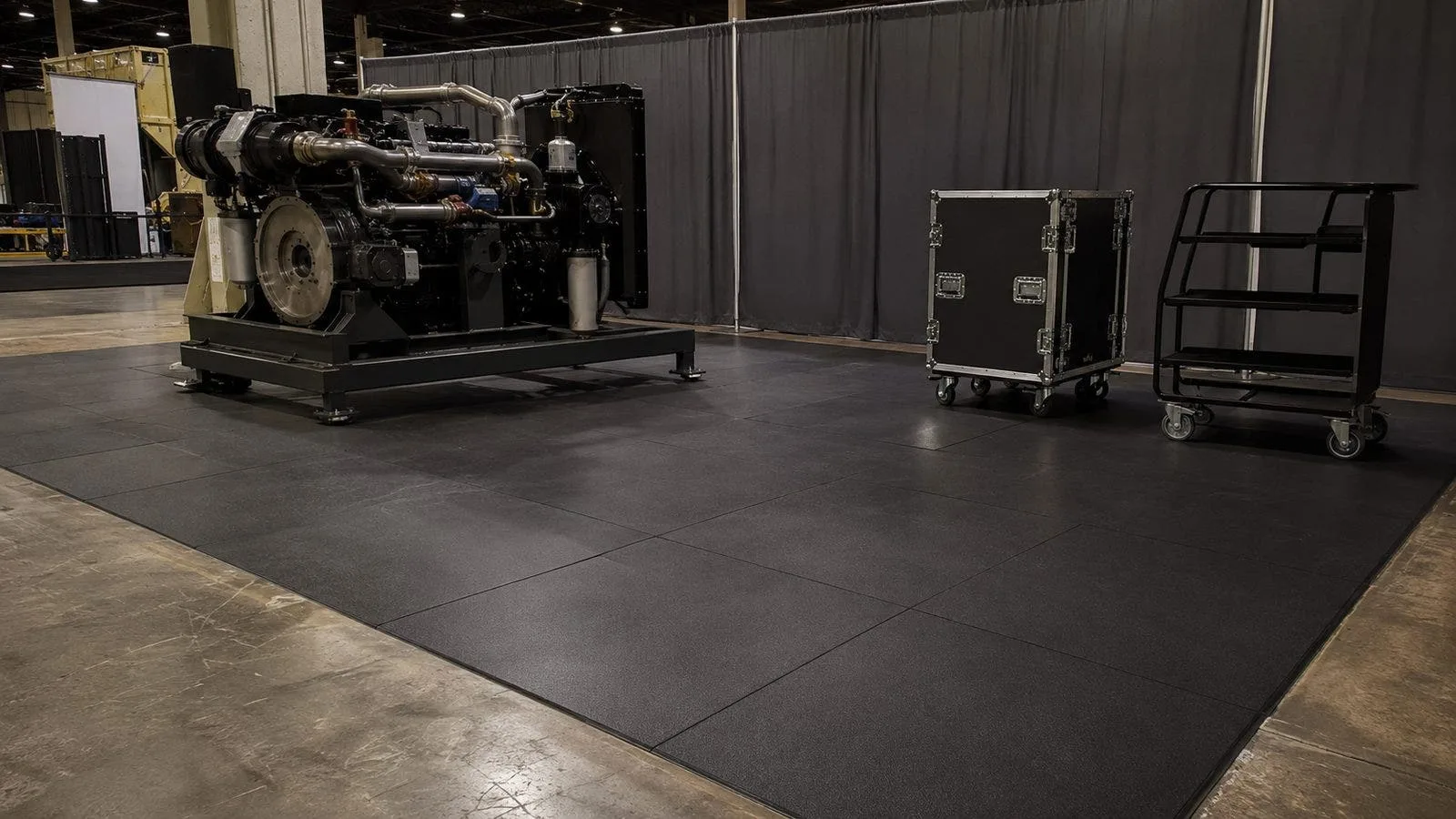
Every floor we sell that covers a 10x10 in under 100 pounds ships by parcel. Anything over 300 pounds ships by freight. The difference between those two paths is wider than the difference in what the floors themselves cost.
Weights come from the published per-tile weights on our own spec sheets, for 100 square feet of coverage. Carton counts assume roughly 25 pounds per box.
| Floor for a 10x10 booth | Weight | Boxes | Carrier | Show handling | All-in |
|---|---|---|---|---|---|
| 1/2" Eco-Soft foam tiles | 25 lbs | 1 | $30 – $45 | $85 | $115 – $130 |
| 5/8" Premium Soft foam tiles | 31 lbs | 2 | $60 – $90 | $85 | $145 – $175 |
| 5/8" Premium Soft Carpet tiles | 43 lbs | 2 | $60 – $90 | $85 | $145 – $175 |
| Premium Soft Wood Grain tiles | 47 lbs | 2 | $60 – $90 | $85 | $145 – $175 |
| 3/8" Impact Foam Rubber tiles | 75 lbs | 3 | $90 – $135 | $85 | $175 – $220 |
| 3/4" Impact Foam Rubber tiles | 100 lbs | 4 | $120 – $180 | $85 | $205 – $265 |
| 3/8" Sport-Lock rubber tiles | 320 lbs | pallet | $270 – $450 | $460 – $780 | $730 – $1,230 |
Field coverage only. Booths on an aisle usually want beveled border pieces around the perimeter, which adds tiles, weight, and sometimes a box. Carrier figures assume a negotiated parcel account; retail counter rates run two to three times higher. Sport-Lock uses a 36 inch tile that doesn't divide evenly into a 10 foot span, so a 10x10 takes 16 tiles plus trimming rather than 25. Check your show's manual for its actual handling rates.
Double the boxes for a 10x20 and the carrier column roughly doubles with them. The $85 handling minimum usually doesn't move until you pass six boxes.
Parcel wins decisively at the light end and erodes as the box count climbs. Somewhere around the 3/4" rubber it stops mattering and you may as well palletize.
How to Avoid Drayage Entirely: Ship to Your Hotel
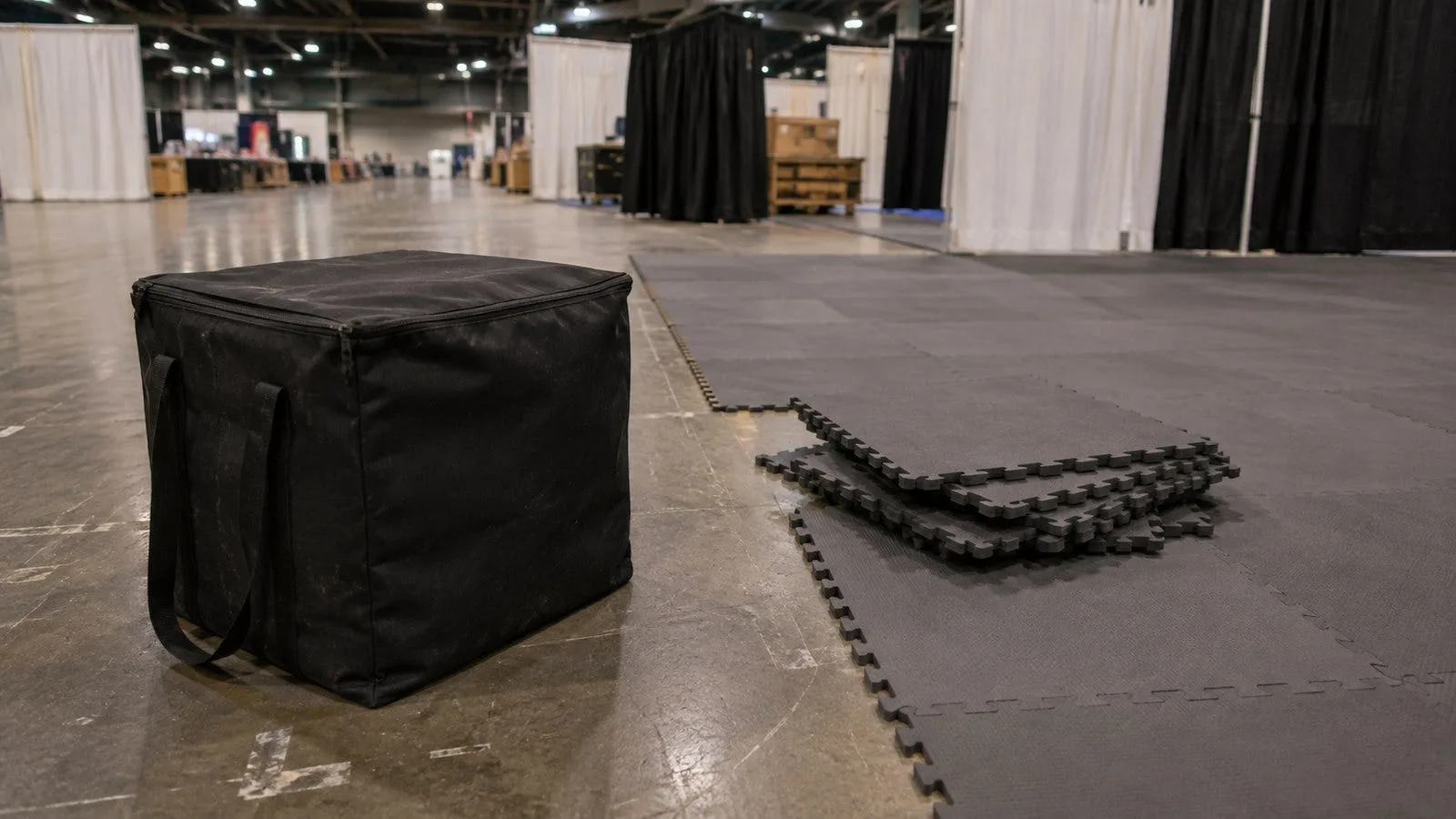
The cheapest way to get booth flooring into a trade show is to ship it by parcel to your own hotel instead of to the show, then carry it in from your vehicle. On a 10x10 foam kit that's $40 to $80 all in, against $115 to $130 for the identical kit shipped to the show.
Call the hotel first and ask their per-box receiving fee. Convention hotels charge to accept and hold packages, commonly $5 to $15 a box, sometimes more, and some add a daily storage charge if it arrives more than a few days early. At the low end it's a rounding error against the $85 drayage minimum. At $30 a box on a four-box kit it isn't. This is a two-minute phone call that decides whether the trick works.
The venue rules matter as much as the hotel's. They vary more than any other rule in this post, and they are not what most guides tell you.
Shepard's exhibitor manual for a 2024 Las Vegas show is strict: unload by hand from a car, minivan, passenger van, SUV, or pickup, no dollies or hand carts, no trailers or box trucks at the dock, 30 minutes to get your material to the booth.
McCormick Place in Chicago is the opposite, and it publishes the rules openly. Park in a McCormick lot and you may hand-carry your items or use a non-motorized, non-hydraulic hand truck or dolly to bring them to the exhibit area, at no cost beyond the daily parking fee. Their ASUV program also lets registered exhibitors unload at a designated dock, free, with a two-person team, one person staying with the vehicle, and a 20 minute unload window. The Teamsters jurisdiction note draws the line at four-wheel dollies, not two-wheel hand trucks. Rosemont's h+h Americas 2026 show goes further still: drive onto the show floor on move-in day, unload with complimentary labor, and use a cart as long as it fits through a single-wide door.
So the honest rule is that hand-carry is usually allowed, wheels are sometimes allowed, and the only way to know is your show's exhibitor manual. If you exhibit in Chicago, check the ASUV page before you budget a cent of drayage.
One more constraint that catches people: most halls that permit hand-carry restrict it to full-time employees of the exhibiting company. McCormick asks for six months of employment and may want proof. If you send a contractor or an agency rep to set up your booth, this route may not be open to you.
If you can't hand-carry, cartload service sits in between. That's the contractor sending one laborer with one cart from the dock to your booth for a flat fee instead of billing by weight. One 2024 show priced it at roughly $190 each way, about $380 round trip, which lands at the top of the full material handling range. It's typically capped at one laborer, one cart, one trip, and under 200 pounds. Run both numbers off your own show's rate sheet.
This is the real argument for a cased tile kit over rolled carpet. A 50 pound roll of carpet and a 50 pound case of tiles weigh the same, but only one of them has handles.
Getting It Home Again
Half the cost and most of the stress of show flooring is the outbound leg, and almost nobody writes about it.
Material handling is billed round trip, so if you paid it inbound, the outbound move is already covered. If you hand-carried in, you hand-carry out, and you owe nothing either direction. What you cannot do is hand-carry in and then decide at teardown that you'd rather the contractor handle it. That reclassifies the shipment and you'll be billed the full rate.
Three things to plan for:
- File your outbound bill of lading with the service desk before the deadline. Miss it and the contractor ships your freight on its own default carrier at its own rate, which is the single most expensive way your floor can travel.
- Don't abandon it. Leaving flooring behind is not free. Shepard's kit names booth flooring specifically and charges a disposal fee plus a minimum hour of labor.
- Keep the case. Multi-show transport without one shortens the floor's life noticeably, and a floor that arrives loose gets surcharged as uncrated freight.
Rent or Buy
One exhibit house documented a general contractor quoting $2,500 to $3,000 to rent carpet for a single 20x20 booth. Four of our 10x10 kits cover the same footprint for $719.96 to $1,157.96, and you still own them afterward.
Published third-party figures put a 10x10 rental at roughly $250 to $400 per show. Against a $179.99 kit, the break-even lands inside a single show and the second show is pure savings.
There's a budget argument here that nobody makes. Most companies capitalize purchases above a threshold, often $2,500, and expense everything below it. A trade show floor kit lands well under that line, so it's typically an operating expense in the year you buy it rather than an asset you depreciate. That's usually the easier conversation with finance, and it's worth raising when you make the case.
Rental still wins in three situations:
- One show, ever. Nothing to store, nothing to ship home.
- A city you'll never work again. Round-trip shipping on an owned kit can exceed the rental.
- A booth that changes size or theme every show. An owned 10x10 won't cover next year's 10x20.
Everything else favors buying, and the advantage compounds through the shipping tiers rather than the purchase price. Carry the kit in yourself and the marginal cost per show is zero. Parcel-ship it to your hotel and you're under a hundred dollars. A rental never gets cheaper than the first time you rented it.
Two costs most rent-versus-buy content omits: storage between shows, which one exhibit house pegged at roughly $100 a year, and tile attrition. Order spares with the original order. Manufacturers change color formulations between production runs, so a tile damaged at show three is a problem if the color has moved by show nine.
Five Things to Confirm in Your Exhibitor Manual
Show rules, not flooring opinions, and getting one wrong costs real money.
1. What are the small package and crated rates for this show? Get the per-carton rate, the minimum, the per-CWT crated rate, and the overtime windows. Surcharges of 30 to 50 percent are common for move-in outside standard hours.
2. Is flooring mandatory, and is there a deadline? Many shows require wall-to-wall covering with no exposed concrete. Some go further. Coverings 2026 states that if your flooring isn't installed by noon on a stated day, the contractor installs carpet at the exhibitor's expense and bills you for it.
3. Can you adhere anything to the hall floor? Often not. The same 2026 manual prohibits adhering tile or any other material directly to the facility floor, with the exhibitor liable for damage. Interlocking tiles sidestep this, which is part of why they're common at shows.
4. Is a flame-resistance certificate required? Ask the venue which standard it enforces, then ask your supplier for documentation on the exact product and color before you ship. Call us and we'll tell you what we hold for anything in this post.
5. Are you allowed to install it yourself? In some cities installation and dismantle falls under union jurisdiction. Self-install is the entire value proposition of a tile kit, so confirm you're permitted in that specific hall.
Lead Time
Everything in this post assumes the floor arrives before the show does.
Stocked tiles and kits ship quickly, but transit is on top of that, and a cross-country ground shipment is several days. If you're shipping to an advance warehouse, that deadline lands weeks before the show opens, not days. Custom colors and larger commercial orders need longer.
If your show is inside 30 days, call before you order rather than after. We'd rather tell you what's actually in stock than have you find out at the dock.
What We'd Buy
Foam if you're doing more than one show a year and cost per show is the number that matters. Cheapest to buy, cheapest to move, and the only category light enough to hand-carry without thinking about it. The catch is heel marks.
Trade show carpet tiles if the booth has to photograph as carpet. Ships almost identically to foam at two boxes and 43 pounds. The padding does flatten after a couple dozen setups.
3/8" rubber if equipment is rolling across the booth, and only then. Still parcel-viable at three boxes.
Sport-Lock if the booth is a demo floor. Never if it's just a floor. It's the one product here that turns a $130 shipping problem into a $1,000 one.
PVC, meaning our Flex Nitro tiles, if the booth photos matter most. Your staff will feel it by hour six.
If you're choosing on looks, comfort, and traffic rating rather than cost, that decision belongs in our best trade show flooring guide. This list is ranked on what each floor costs you per show.
Trade Show Flooring Cost FAQs
How much does trade show flooring cost?
Tiles for a 10x10 booth cost $119 to $349, and complete kits run $179.99 to $289.49. Shipping adds $115 to $130 to get them to the show, or $40 to $80 if you ship to your hotel and carry them in.
What is drayage at a trade show?
Drayage, also called material handling, is what the show's general contractor charges to receive your shipment at the venue dock, move it to your booth, store your empty cases during the show, return them, and load you out. It's billed round trip and it's separate from what your carrier charged to reach the building. You don't choose the contractor. The show does, and its rates are published in the exhibitor services manual.
How much does trade show drayage cost?
For crated or palletized freight, published 2024 to 2026 rate sheets run roughly $1.15 to $1.95 per pound round trip, or $115 to $195 per CWT, with many contractors setting a 200 pound minimum. Rates vary enormously by show: we found $115 per CWT at a May 2026 Illinois show and $194.25 at a June 2026 Baltimore show. Parcel shipments bill under a separate small package rate instead, commonly with an $85 minimum.
Can I ship trade show flooring by FedEx or UPS?
Yes, and for anything under about 100 pounds it's the cheaper path. It does not avoid material handling. Parcel deliveries bill under the show's small package rate, per carton rather than per pound. Watch two things: classification usually caps around 30 pounds per carton, and carriers that split a shipment across delivery days can trigger a separate fee for each day.
Can I carry my own materials into a trade show?
Usually, with restrictions that vary a lot by venue. A 2024 Las Vegas manual permits unloading by hand from a personal vehicle but prohibits dollies and hand carts and caps you at 30 minutes. McCormick Place in Chicago permits a non-motorized hand truck from the parking lot at no cost beyond parking. Most halls limit hand-carry to full-time employees of the exhibiting company. Read your own show's manual.
Is it cheaper to rent or buy trade show flooring?
Buy, in almost every case. A $179.99 kit breaks even against a single show's $250 to $400 rental. Renting only wins for a one-off show, a city you'll never return to, or a booth whose size changes every time.
How many tiles do I need for a 10x10 booth?
Twenty-five tiles at the standard 2 by 2 foot size, which is 100 square feet. A 10x20 needs 50 tiles, a 20x20 needs 100. Larger formats change the count: 3/8" Sport-Lock uses a 36 inch tile, so a 10x10 takes 16 tiles plus trimming. Add border pieces if your booth sits on an aisle.
Why Exhibitors Buy From Us
FlooringInc has been shipping flooring since 2007, including to broadcast sets where the floor has to be down before a fixed call time in a venue nobody on the crew has walked before. A show move-in with a noon carpet deadline is the same problem on a different clock.
We ship over 2,000 free samples a month, so there's no reason to guess at how a floor feels before you commit a booth to it.
Get a Real Number for Your Show
Send us your show, your city, and your booth size and we'll come back with a line-item estimate: tiles, border pieces, carrier cost, and that show's published handling rate. That's the number you need for a budget, and it isn't on anybody's website.
ORDER FREE SAMPLES if you want to feel the difference between foam, carpet, rubber, and PVC first.
Related Content >> Trade Show Flooring Options | Auto Show Guide: Car Show Display Flooring | How to Install Foam Tiles