Home Gym vs. Gym Membership: The Real 5-Year Cost
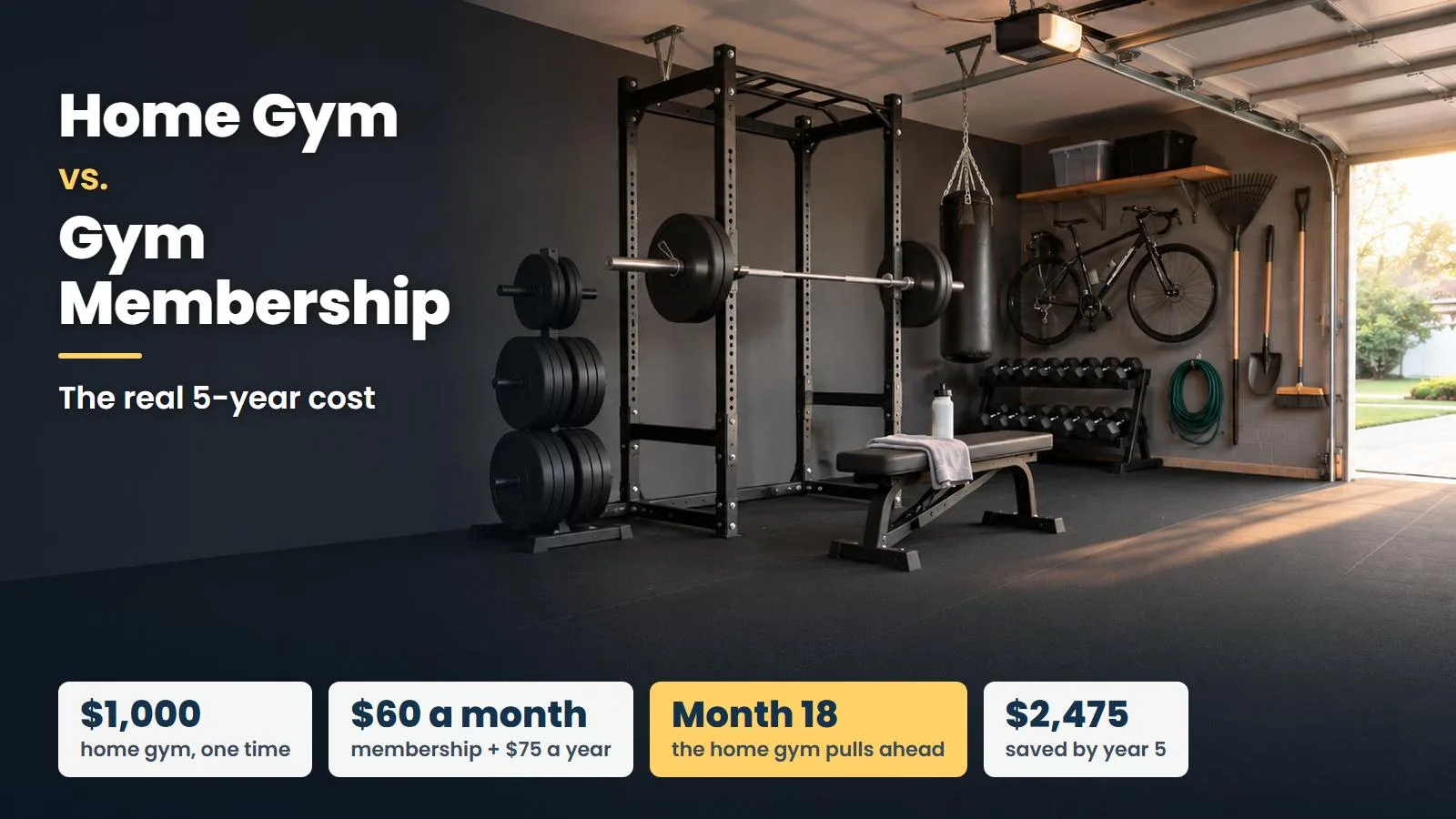
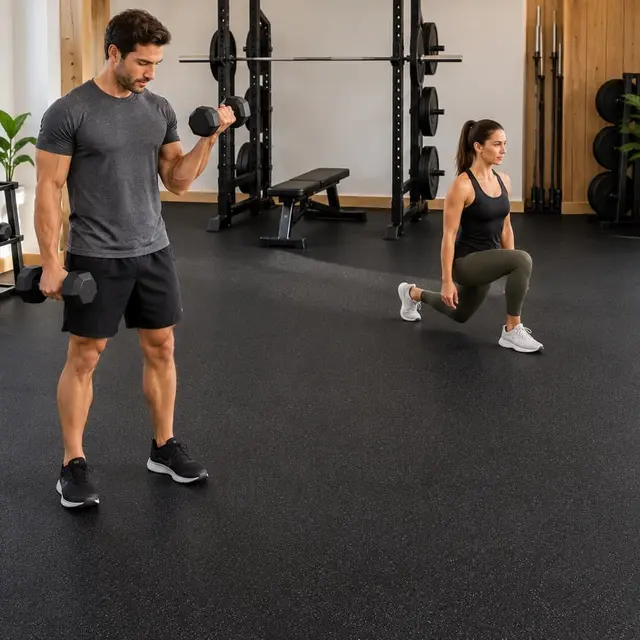
Top image: illustration created with AI for this article.
A starter home gym under $1,000 doesn't require a massive check upfront, and a commercial gym membership doesn't stay cheap forever. With a $1,000 starter setup (adjustable dumbbells, a bench, and a small rubber mat area) against a $60-a-month membership plus a $75 annual fee ($66.25/month all in), you break even in about 18 months, even after allowing for $100 a year in upkeep. Scale up to a full $2,500 barbell garage gym, and you cross the break-even line around month 44 (or month 21 if two adults train at home).
But numbers only tell half the story. The real winner isn't the cheapest option on a spreadsheet. It's the one that gets you off the couch on a rainy Tuesday when you're exhausted.
We sell gym flooring, so we have a stake in this and you should know it. That's why we link every study below and lay out all our assumptions, so you can plug in your own numbers. We also dedicate a full section to when a commercial membership is the smarter buy. All prices and figures were checked on November 20 to 23, 2026.
Quick answers: home gym vs. gym membership
- Which is cheaper? A starter home gym under $1,000 can beat a $66.25/month membership in about 18 months (with $100/year upkeep). A larger $2,500 barbell gym takes closer to 44 months to pass that same membership, then saves $975 at five years and $4,450 at ten.
- When does a home gym pay for itself? Divide your setup cost by your all-in monthly dues. A $1,000 starter setup against $66.25 a month breaks even around month 18 with upkeep; a $2,500 gym breaks even around month 38 on equipment alone, or month 44 with upkeep.
- Is a home gym worth it? Yes, if you'll train a few times a week for several years and have space to claim as your own, whether that's a compact starter nook or a 100 sq ft barbell zone. Against a $25 budget gym membership, the math is much harder to beat.
- Which one will you actually use? Research doesn't crown a universal winner. Gym members report far more exercise than non-members, yet new-member attendance drops sharply within a year. In one year-long trial of older adults, home workouts held up better than group classes.
- Who should buy a membership? Beginners who want hands-on coaching, people who thrive on group classes, and anyone who needs the energy of a room full of people to show up.
- Who should build a home gym? Self-starters, busy parents tired of juggling schedules, experienced lifters who hate waiting for a rack, and households where two or more people train.
Home gym cost vs. gym membership cost
A gym membership typically runs anywhere from $10 to $100+ a month. A home gym ranges from under $1,000 for a lean, high-impact starter setup to about $2,500 for the full barbell garage gym in our example.
Start with the membership, because it's the number most people underestimate. Budget chains run $10 to $25 a month, mid-priced clubs $40 to $80, and boutique or luxury clubs easily pass $100. Published surveys put the typical U.S. membership near $50 a month, and our guide to choosing the best gym membership breaks down what you actually get at each tier.
The sticker price is rarely the whole bill. Most clubs tack on an annual maintenance fee, an enrollment fee, or both. For this guide, we use $60 a month plus a $75 annual fee, which comes to $795 a year, or $66.25 a month all in. That sits right in the middle of the mid-tier market. If your club charges more or less, the break-even tables below show how both a sub-$1,000 starter setup and larger builds stack up.
Starter home gym vs. a sample $2,500 budget
You don't need a full rack of iron on day one to get strong at home. A focused starter setup (adjustable dumbbells, a sturdy bench, a few extras, and a dedicated rubber floor) comes in around $1,000 in planning allowances. Step up to a full barbell garage gym with a power rack and bumper plates, and your budget moves closer to $2,500.
| Item | Allowance | Notes |
|---|---|---|
| Power rack or squat stand | $600 | Added in the full $2,500 barbell gym build |
| Barbell | $250 | One quality bar will outlast almost everything else here |
| Plates (about 300 lb) | $550 | Bumper plates cost more than iron, but they're much kinder to your floor |
| Adjustable dumbbells | $400 | One smart pair replaces an entire rack of fixed weights (included in starter path) |
| Adjustable bench | $250 | Core strength piece (included in starter path) |
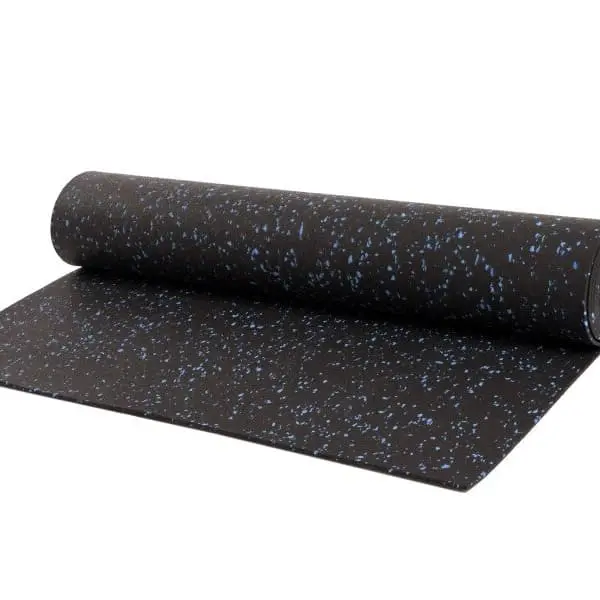
| Rubber flooring, 150 sq ft | $290 | 8mm Strong Rubber Gym Flooring Rolls in Black at $1.91 per sq ft, before shipping. Budget Rubber Flooring Rolls - Best Value brings this down to about $248 (a smaller starter mat area costs even less) |
| Mirror, storage, bands, collars | $160 | |
| Full barbell gym total | $2,500 | Starter path (dumbbells, bench, a smaller rubber floor and bands): about $1,000 |
Starting under $1,000 lowers the financial risk. You get real weights at home without tying up thousands of dollars upfront. On the flip side, you can spend far more, usually once commercial-grade cardio machines enter the picture.
When a home gym pays for itself
A starter home gym of about $1,000 against a $66.25-a-month membership (dues plus annual fee) pays for itself in about 18 months once you include $100 a year for upkeep. A larger $2,500 barbell setup crosses the finish line around month 44 with that same $100 annual upkeep buffer, which covers wear like fresh bands or a replacement bench pad.
| After | Home gym (with $100 a year upkeep) | Gym membership | Difference |
|---|---|---|---|
| 1 year | $2,600 | $795 | Membership ahead by $1,805 |
| 3 years | $2,800 | $2,385 | Membership ahead by $415 |
| 5 years | $3,000 | $3,975 | Home gym ahead by $975 |
| 10 years | $3,500 | $7,950 | Home gym ahead by $4,450 |
Two variables move that crossover date faster than anything else: what your local gym charges, and how many people under your roof lift. For two adults training together on a $2,500 barbell setup, break-even drops from month 44 to month 21 with upkeep.
From a FlooringInc customer
"My husband & I installed it ourselves in our home gym. It looks & feels great."
Customer review of 8mm Strong Rubber Gym Flooring Rolls, 5 out of 5 stars
| All-in membership cost | $1,000 home gym | $2,500 home gym | $5,000 home gym |
|---|---|---|---|
| $25 a month (budget chain) | 40 months | 100 months | 200 months |
| $50 a month | 20 months | 50 months | 100 months |
| $80 a month | 13 months | 32 months | 63 months |
| $150 a month (premium or two members) | 7 months | 17 months | 34 months |
Look closely at the $1,000 column. Against a $66.25/month mid-tier membership, a ~$1,000 starter setup breaks even around month 18 with $100/year upkeep, or month 15 to 16 before upkeep. Against an $80/month club, it pays off in right around a year before upkeep. Even against a $25 budget membership, a $1,000 setup takes just over three years, whereas a $2,500 barbell gym takes over eight years (and more than twelve with upkeep).
Spreadsheets never capture everything. Quality racks, bars, and plates hold real resale value while a membership leaves you with zero equity, though resale prices vary too widely to model cleanly. These tables also leave out shipping, sales tax, and the square footage your gym claims at home.
Working out at home vs. at the gym: what the research says
Science doesn't declare a universal winner between training at home and joining a club. There isn't a massive head-to-head trial pitting home gym owners against commercial gym members, so we look at what the data reveals about each habit.
Gym members exercise more, though correlation isn't causation
A 2017 study in PLOS ONE from Iowa State University compared 204 health club members with 201 non-members. Members reported about 484 minutes of aerobic activity a week versus 137 for non-members, and 75% met both aerobic and strength guidelines compared to just 18% of non-members.
That's a striking gap. Still, because it's a snapshot of self-reported habits, we can't know whether the membership sparked the routine, or if people who already love working out simply buy memberships.
New-member motivation fades fast
A 2020 study in Psychology of Sport and Exercise tracked 1,726 new gym members over twelve months. Average visits plunged from 7.48 in month one to 0.92 by month twelve. On a $60 monthly plan, 0.92 visits means paying roughly $65 every time you walk through the door.
Economists spotted this exact trap years earlier. In a famous 2006 paper in the American Economic Review, members paying over $70 a month averaged just 4.3 visits a month, or about $17 per workout, even though the exact same clubs sold $10 day passes.
Fewer memberships go completely unused today
Recent industry data offers a brighter picture. The Health & Fitness Association reports that 81 million Americans belonged to a fitness facility in 2025, logging an estimated 7 billion visits. The share of members who never swiped in once dropped to 4.6%, down from roughly 10%.
Home programs can stick, at least for older adults
In a year-long trial published in JAMA in 1991, 357 previously sedentary adults aged 50 to 65 were split between group classes and home-based workouts. The home-based groups stuck with it better across the full year. A 2005 Cochrane review echoed those findings for older adults (noting it relied heavily on that trial). Following a guided home program isn't identical to owning a garage rack, so take this as encouraging evidence that home habits can stick, not a guarantee.
What this means for your routine
Be honest about what has derailed your workouts in the past. If it was the commute, crowded peak hours, or waiting around for equipment, a home gym erases those excuses overnight. If it was that nobody notices when you hit snooze, training alone at home will make skipping even easier.
The cost nobody puts in the table: time
Take the 6 p.m. rush. If your gym is a 20-minute drive away, five workouts a week adds up to 173 hours a year behind the wheel, before you even find a parking spot. That is more than seven full days of your life spent commuting before you even touch a barbell. Even at three workouts a week, you're losing 104 hours a year behind the wheel.
If your gym is five minutes down the road, skip ahead. Otherwise, do your own commute math before deciding. For most busy adults, the drive is what kills a great fitness habit. When your dumbbells and bench are a few steps away at home, a 25-minute lunchtime or pre-work session actually happens. You don't need a free hour. You just walk through the door, hit play on your playlist, and lift.
From a FlooringInc customer
"We put it in our [12 ft by 12 ft] home gym. We have free weights, bench, and a bike. Floor is solid for the weights yet soft enough to sit on the floor."
Customer review of 8mm Strong Rubber Gym Flooring Rolls, 5 out of 5 stars
What a home gym needs that a membership doesn't: space, a floor and quiet
A starter home gym can fit in a small corner, while a full barbell setup needs about 100 sq ft, and both benefit from a dedicated rubber floor and a realistic plan for noise. Most comparison guides gloss right over these three realities, yet they're what make or break a home setup.
Space
A starter setup with adjustable dumbbells and a bench can fit in a compact nook or corner (around 6 ft by 8 ft). A power rack with a 7 ft Olympic barbell requires a clear 10 ft by 10 ft footprint once you leave room to load plates, so plan on 100 sq ft as your working minimum for barbell training, or 150 to 200 sq ft if you add extra gear or cardio. Always measure ceiling height before ordering a rack if you plan to press overhead or do pull-ups.
Home gym flooring
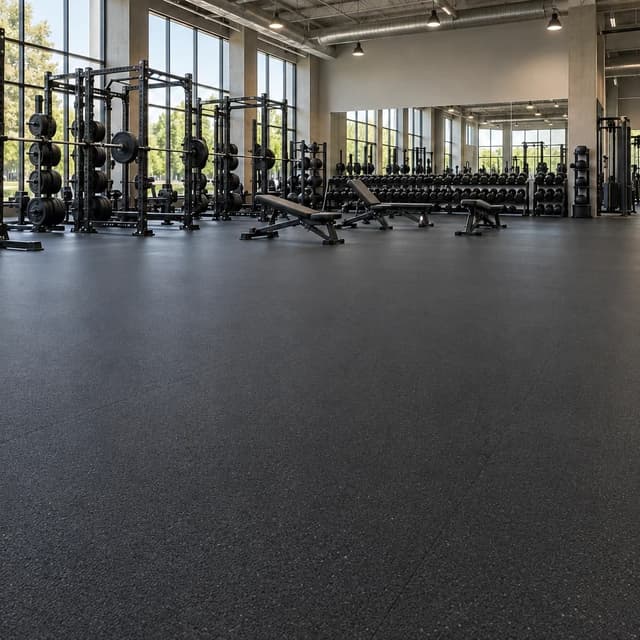
If you lift weights at home, put real rubber underneath them. Bare concrete chips under dropped weights and chews up knurling, while carpet and hardwood take an even worse beating. A dedicated rubber floor protects your subfloor, locks in solid footing, absorbs vibration, and turns a cold concrete bay or spare corner into a space you want to train in. It's also affordable: roughly $250 to $290 for 150 sq ft of 8mm black rubber on November 23, 2026, before shipping (and even less for a smaller starter mat footprint).
- Our highest-quality rubber: 8mm Strong Rubber Gym Flooring Rolls. Made by our top manufacturing partners, this is our flagship roll and the one we recommend for most home gyms. Black was $1.91 per sq ft on November 23, 2026. Rolls are 4 ft wide and sold by the linear foot, so 150 sq ft takes 38 linear feet, about $290 before shipping.
- Rock-bottom price: Budget Rubber Flooring Rolls - Best Value. If keeping upfront costs tight is priority number one, this is our most affordable roll. The 8mm roll in Black was $1.63 per sq ft on the same date, or roughly $248 for 150 sq ft.
- Free weights and heavier use: 3/8" Heavy Duty Rubber Flooring Rolls | Commercial Gym Flooring, $2.13 per sq ft in Black on the same date, bringing 150 sq ft to about $324.
- Deadlifts and dropped barbells: layer 3/4" Extreme Heavy Duty Rubber Gym Mats | Utility Floor Mats directly over your lifting zone. They measure 4 ft by 6 ft and ran $80.99 each in Confetti or $118.49 in Black on November 23, 2026.
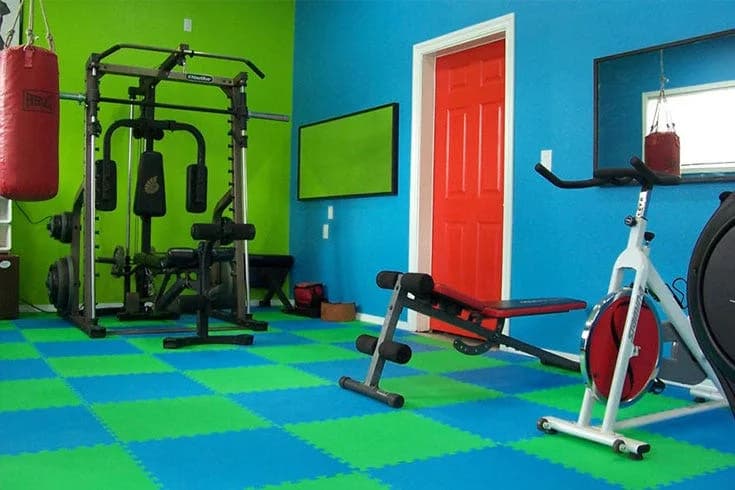
- No cutting, easy to take with you: 8mm Strong Interlocking Rubber Gym Floor Tiles at $2.40 per sq ft on November 23, 2026. These tiles lock together like puzzle pieces and lift right back up whenever you move. (If you rent, check your lease first.)
All prices reflect what our product pages showed on November 23, 2026. Check each product page for today's live pricing.
From a FlooringInc customer
"This product worked great for my home garage gym. The flooring is thick enough to keep my Olympic weights from banging on the concrete underneath…"
Customer review of 8mm Strong Rubber Gym Flooring Rolls, 5 out of 5 stars
Want to compare thicknesses and formats side by side? See our home gym flooring guide, rubber tiles vs. rolls, or home gym flooring by budget.
Noise
Rubber takes the sharp edge off impact, but it won't make a dropped barbell whisper-quiet, especially on an upper floor. If you live above neighbors or share a wall, plan on controlled eccentrics, thicker 3/4" mats under heavy lifting zones, and skipping 5 a.m. heavy deadlifts. Renters should always double-check their lease before bolting down a rack. A ground-floor room or concrete garage slab is the easiest setup by far.
What a membership buys that a home gym can't
A great commercial gym gives you four things that are tough, or expensive, to recreate at home.
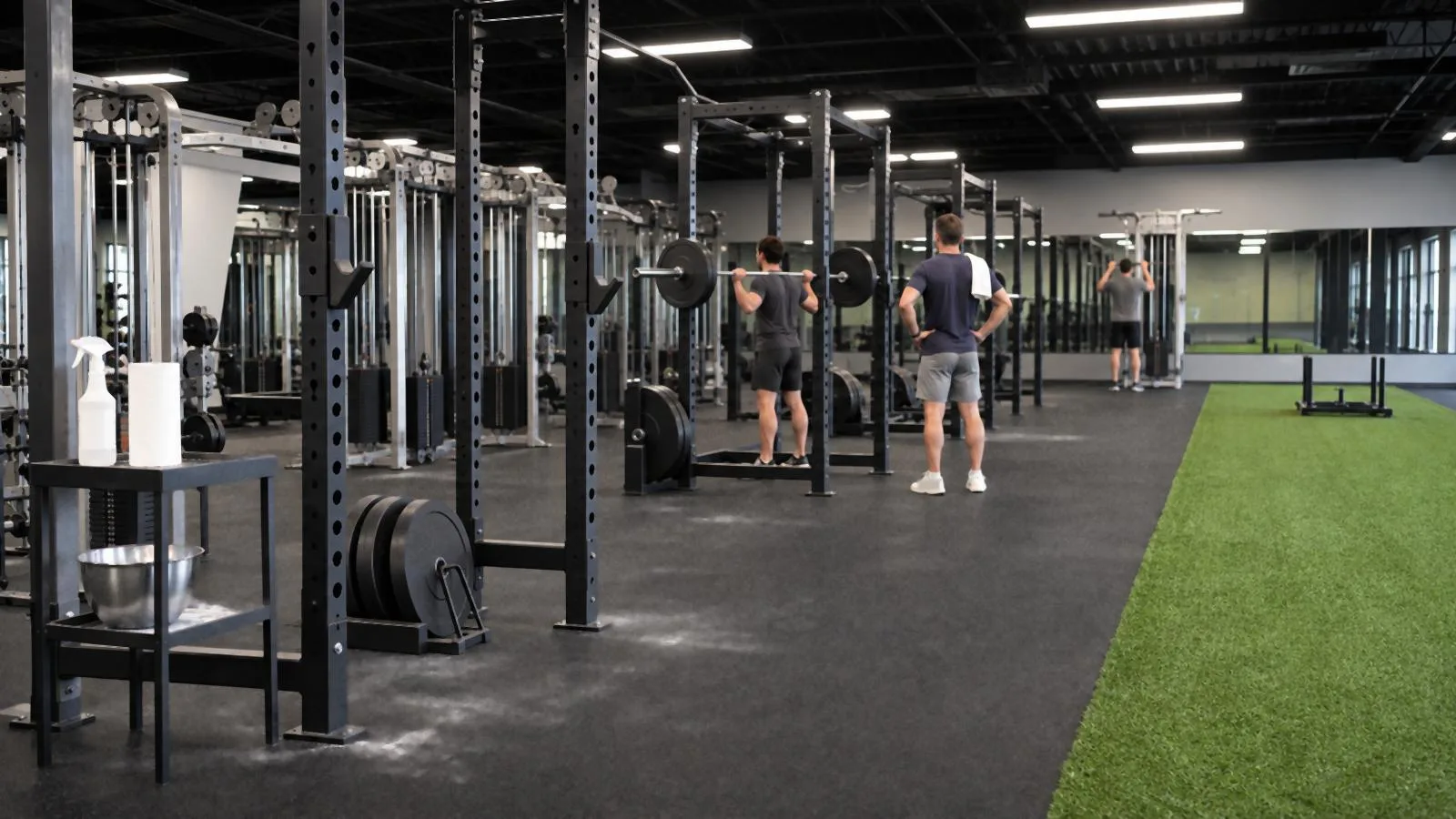
- Equipment variety. Selectorized cable stacks, leg presses, rows of cardio machines, maybe even a lap pool or sauna. Matching a fraction of that footprint at home costs many times a starter setup or even our $2,500 barbell budget.
- In-person coaching. If you're brand new to lifting, a few months with a sharp trainer watching your form is worth more than any piece of steel.
- Classes and community. For plenty of people, an upbeat instructor or a training partner waiting by the door is the entire reason they show up.
- Zero commitment to your space. A membership asks nothing of your garage and cancels with a phone call. A 300-pound power rack is a lot harder to return.
The trade-offs are the ones you already feel: the commute, fighting for a squat rack at 6 p.m., and a monthly draft that hits your card whether you went once or twenty times.
Home gym vs. membership: who should choose which
| If this sounds like you | Usually the better choice | Why |
|---|---|---|
| New to exercise | Gym membership | Coaching and a low-risk way to discover what training styles you enjoy |
| You go for the classes | Gym membership | A home rack can't replace a live instructor and a packed studio |
| You skip workouts unless someone expects you | Gym membership | Built-in accountability is what your dues are really buying |
| Self-motivated, with a routine you already follow | Home gym | You'll use it, so both the fitness and financial math work, even on a sub-$1,000 starter setup |
| Short on time, or a parent of young kids | Home gym | Zero commute and zero childcare logistics |
| Two or more people in the house train | Home gym | Your break-even timeline gets cut sharply |
| Experienced lifter who knows what you need | Home gym | You buy only the gear you love and never wait in line for it |
| Renting, upstairs, or likely to move soon | Gym membership, or a compact home kit | Space limits, floor noise, and moving heavy steel work against you |
The hybrid option: a home gym plus a budget gym membership
You don't have to pick an all-or-nothing camp. A lean sub-$1,000 starter setup paired with a $25-a-month budget membership gives you fast, friction-free lifts at home on busy days, plus access to heavy machines, a pool, or a change of scenery whenever you want it, while still costing less over five years than a single $66.25/month mid-tier membership. Grab dumbbells, a bench, and a small rubber floor, keep a cheap membership for six months if you want, and see where your feet naturally take you.
Home gym vs. gym membership FAQ
Is a home gym actually cheaper than a gym membership?
Often much sooner than most people think, especially if you start small. A starter home gym under $1,000 can beat a $66.25/month membership in about 18 months (with $100/year upkeep). A larger $2,500 barbell setup takes closer to 44 months to pass that membership, then saves $975 by year five and $4,450 by year ten. The main exception is a $10–$25 budget chain, which takes much longer for a $2,500 setup to beat on price alone.
How much should I budget to build a home gym?
You can put together a capable starter setup for about $1,000 (using adjustable dumbbells, a sturdy bench, and rubber flooring) or budget roughly $2,500 for a full barbell garage gym with a rack, bar, and 300 lb of plates. Adding commercial cardio machines or specialty racks can push totals past $5,000.
How do I calculate my personal break-even date?
Take your total home gym budget and divide it by your true all-in monthly gym bill (dues plus annual fees divided by 12). A ~$1,000 starter setup against $66.25/month breaks even in about 18 months with $100/year upkeep; a $2,500 barbell gym equals 38 months on equipment alone, or 44 months with upkeep (and about 21 months with upkeep for two lifters).
Is building a home gym worth it if I don't have a huge garage?
Yes. A starter setup with adjustable dumbbells and a bench can fit in a small corner or spare nook, while a barbell setup wants roughly 100 sq ft (a 10 ft by 10 ft area). What matters most isn't square footage. It's whether you enjoy training independently at least a few times a week.
Do I really need rubber gym flooring at home?
If you're lifting weights, yes. Rubber keeps dropped iron from cracking concrete or ruining hardwood, protects your plates and dumbbells, gives you non-slip traction, and dampens sound. Most home lifters go with 8mm or 3/8" rubber rolls or tiles, adding 3/4" heavy-duty mats under deadlift zones. On November 23, 2026, covering 150 sq ft ran about $290 for our 8mm Strong Rubber Rolls or $248 for our Budget Rubber Rolls (before shipping), with smaller starter areas costing less.
Can you get just as strong working out at home?
Yes. Muscle and strength respond to progressive overload and consistency, not the logo on the building. Even a compact dumbbell-and-bench starter setup or a full barbell rack covers the fundamentals. The only things you trade away are specialty cable machines, group energy, and on-site trainers.
Home gym or gym membership? The bottom line
The best gym is the one where you show up. If you thrive on group classes, live coaching, or the buzz of a busy floor, buy the membership and enjoy every session guilt-free. But if you already know how to train, value your time, and want a low-friction space that's always open with zero commute (whether you start under $1,000 or build a full garage rack), building a home gym pays off fast.
Ready to turn that corner of your garage or spare room into a space you're proud to walk into? Start from the ground up, since every lift starts on your floor. Explore our gym flooring and garage gym flooring collections, or order free samples to feel the thickness and grip in your hands before you build.
Gym FlooringBuying Guidehome gymgym membershiphome gym costgym flooringrubber flooring